
PM Modi Interacts with Youth of Seva Sankalp Yatra, Highlights Vision of a Developed India…
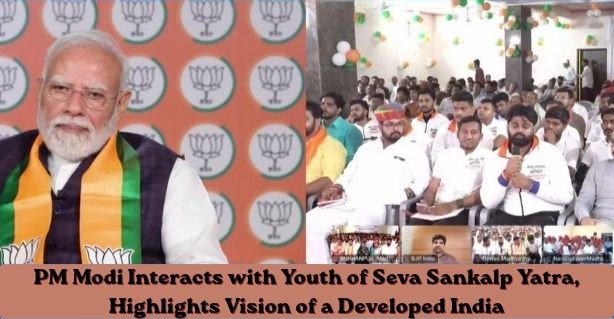
PM Narendra Modi held a discussion with some of the volunteers who had come through the Seva Sankalp Yatra program initiated by the government, which was meant to make the journey from Vadnagar in Gujarat to Varanasi in Uttar Pradesh. In his speech, he highlighted the importance of service and social responsibility of the youth generation. PM talked about the vision of Viksit Bharat till 2047 and also highlighted that youth would play an integral part in fulfilling this vision. He spoke about the importance of working among the masses. Also, Modi ji highlighted the concept of Saptadhara or the seven streams of Shakti that consisted of manufacturing, agriculture, technology, innovation, infrastructure, defense, the green and blue economy, and soft power of India. According to him, these streams were essential for the development of a strong nation. The Seva Sankalp Yatra which began on September 17 is a youth-led movement in which the individuals take part in various activities as they travel around the nation. In the Seva Sankalp Yatra, several activities have been carried out, such as cleanliness drives, planting trees, cultural programs, as well as activities in schools and hospitals and other community organizations. The interaction comes as Seva Sankalp Abhiyan continues to gain momentum across the country. The 25th anniversary of Modi’s public life initiative, aims to promote the spirit of service, and encourage youth participation in various community and nation-building activities. The journey from Vadnagar to Varanasi, is planned to continue till October 7.
PM Modi’s 76th birthday today, BJP to launch ‘Sankalp Seva Abhiyan’; grand Deepotsav to be held in Ujjain…
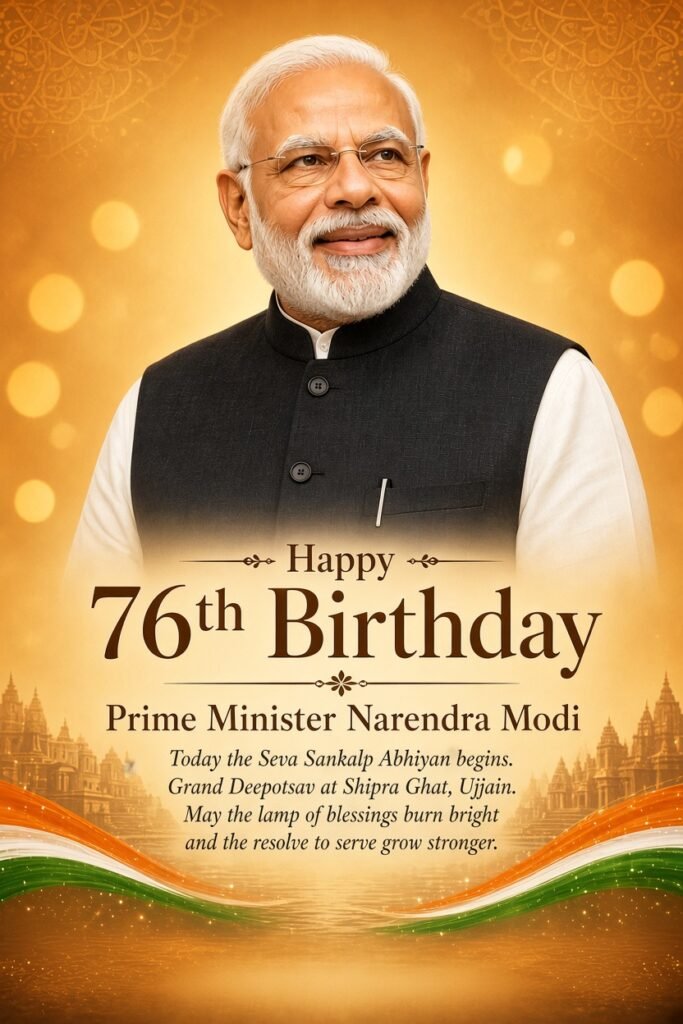
Prime Minister Narendra Modi is celebrating his 76th birthday today, September 17, 2026. To mark this occasion, the Bharatiya Janata Party is organizing numerous public service and social programs across the country. The BJP has launched a month-long “Seva Sankalp Abhiyan” from September 17 to October 17 to mark the PM’s birthday and his 25 years in public life. This campaign includes blood donation camps, health checkups, cleanliness drives, tree plantation, and other public welfare activities. A special festival of lights is being organized in Ujjain, Madhya Pradesh, to mark the PM’s birthday. More than 2.5 million earthen lamps will be lit on the banks of the Shipra River and in the Mahakal Lok Kshetra. The event has been named “Aashirwad Ka Diya.” The entire region has been divided into sectors and sub-sectors, and thousands of volunteers have been assigned responsibilities. According to the administration, preparations have been made to keep the event “zero-waste” and to focus on cleanliness and waste management. Various events are also being held in other parts of the country to mark the PM’s birthday. In Gujarat, under the “Aashirwad No Divdo” program, plans are underway to light over 8.8 million diyas at over 18,500 locations. Additionally, events such as tree plantation, cow service, and bike rides are also being organized. A bike ride from Vadnagar to Varanasi is also being organized in Gujarat, marking the completion of 25 years of Modi’s public life. Leaders from various political parties, including President Draupadi Murmu, have extended their greetings to PM Modi on his birthday. According to the BJP, the “Seva Sankalp Abhiyan” focuses primarily on public participation and public service. Health camps, blood donation, cleanliness, tree planting, and awareness activities related to government schemes are also being organized in Delhi, Uttarakhand, Maharashtra, and several other states.
Congress to March to Uttarakhand CM’s Residence on Sept 7 Over ‘Purification’ of Kharge Rally Stage…
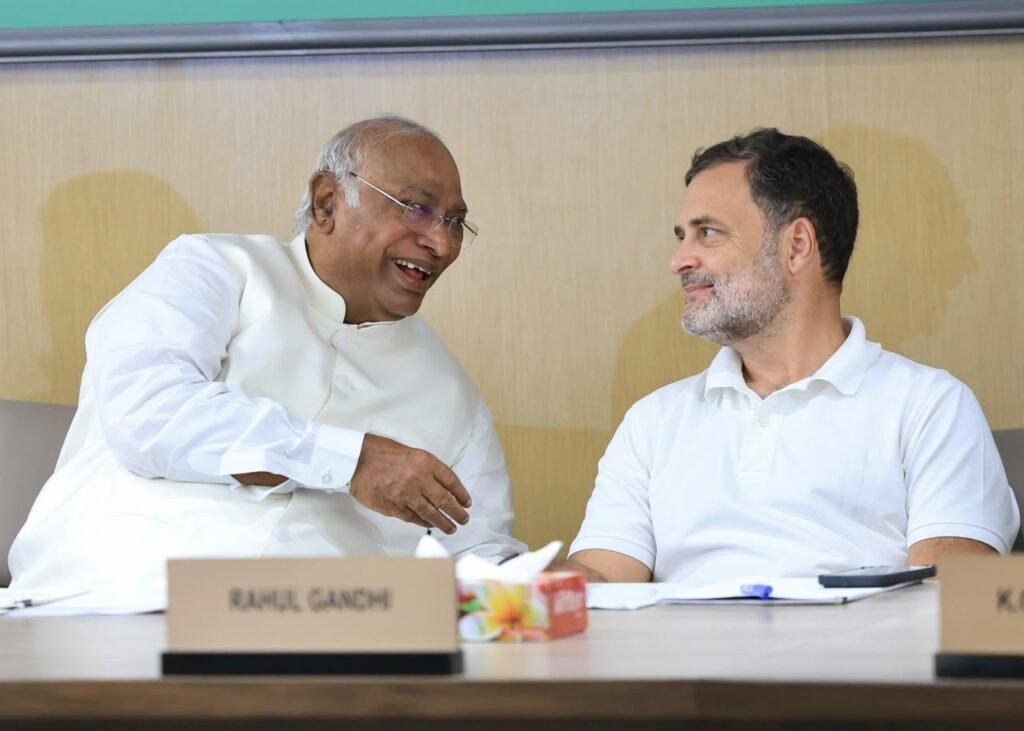
The controversy that erupted after Congress National President Mallikarjun Kharge’s rally in Haldwani has now escalated into a political movement. Congress has begun preparations to increase pressure on the government on this issue. As a result, the Congress Party is planning to march to the Chief Minister’s residence in the state capital, Dehradun, on September 7th, 2026. Lok Sabha Leader of the Opposition Rahul Gandhi and Congress General Secretary Priyanka Gandhi are also expected to participate in this major political protest. The primary reason for this controversy is a large Congress Party public meeting held on August 8th, 2026, at the Ramlila Maidan in Haldwani, Uttarakhand, addressed by Congress National President Mallikarjun Kharge. Two days after the rally, on August 10, 2026, individuals associated with some Hindu organizations (allegedly Shri Ram Sena) sprinkled Ganga water on the stage and grounds amid chanting of Vedic mantras and performed a “havan” (sacrifice). Photos and videos of this incident went viral on social media. The Congress party has taken this incident to be extremely serious and has directly labeled it an act of “caste discrimination and untouchability.” Mallikarjun Kharge belongs to the Scheduled Caste (Dalit) community. The Congress alleges that Kharge’s presence alone was the reason for the “purification” of the grounds, reflecting a feudal and casteist mindset. Mallikarjun Kharge himself raised the issue in the Rajya Sabha, calling it an act of untouchability and demanding the arrest of the perpetrators. Rahul Gandhi, the Leader of the Opposition in the Lok Sabha, also strongly criticized the incident, calling it against the Constitution and human values. Meanwhile, the Congress party alleges that the police have not yet filed an FIR against those responsible for the purification incident. Furthermore, the Congress party is demanding the cancellation of the cases filed against Rahul Gandhi. The Congress party will now march to the Chief Minister’s residence on September 7th to protest the purification incident. State Congress leaders have begun preparations to make the march a success. According to party sources, Rahul Gandhi and other national leaders may also participate in the rally. However, the Congress party has not yet formally announced this.State Congress President Ganesh Godiyal stated that party workers from across the state will march to the Chief Minister’s residence on September 7th. The Congress party will continue to fight the purification issue to the last minute. He added that no schedule for Rahul Gandhi’s arrival at the rally has been finalized.
CJP Workers Protest Outside Delhi’s Parliament Street Police Station Demanding Justice in Sanjay Kumar Assault Case…
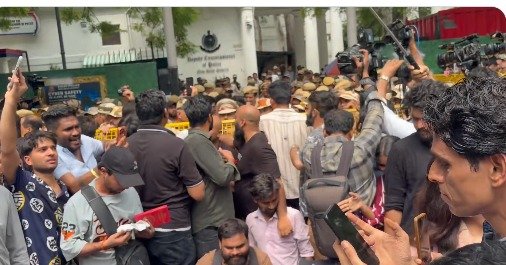
Cockroach Janata Party (CJP) workers arrived in large numbers to protest at the Parliament Street police station in Delhi today, Friday (September 4, 2026). Workers and senior leaders of the youth organization, Cockroach Janata Party (CJP), have been protesting and raising slogans against the Delhi Police outside the Parliament Street police station since morning. CJP leader Saurav Das, along with other members, has reached the Parliament Street police station, demanding justice for Sanjay and Nishu. Meanwhile, Nishu, Chandrashekhar Azad, Saurav Das, and Ashutosh Ranka have reached the DCP’s office. This protest is related to the attack on Sanjay Kumar, the father of Nishu Azad, a young woman who participated in the protest at Jantar Mantar. Sanjay Kumar was allegedly attacked by a young man named Swatantra Bhardwaj. The CJP alleges that the Delhi Police has not taken any action against him. Several other leaders, including the CJP, are protesting outside the Parliament Street police station in Delhi. In fact, the issue reignited when the accused, Swatantra Bhardwaj, openly confessed to the attack on the father of a CJP worker in a podcast. He stated that he did not go to jail even after the attack because he had connections with political figures. Nishu also posted a video on the matter, appealing to Rahul Gandhi for help. Following this, Rahul Gandhi assured Nishu of his support. In his post, Rahul Gandhi wrote, “Nishu, there’s no need to panic. I am with you. It’s clear that you were targeted because you speak out for the rights of your community and students. Amit Shah’s Delhi Police, on the one hand, commit inhumane brutality against students. On the other hand, the criminal who beheaded a Dalit girl’s father roams freely. PM Modi, Home Minister Amit Shah, why are you and your party members protecting such a criminal? Will action still be taken, or will you continue to protect someone?” Nishu, your fight is not alone. We will not stop until justice is served. Jai Bhim. Jai Constitution.” Delhi Police, meanwhile, issued a statement on the matter, dismissing the social media claims as rumors. Police say that according to doctors at RML Hospital, Sanjay Kumar suffered minor injuries caused by a bracelet. Reports of a crack in his head are baseless. According to the police, the accused (Suraj Kumar and Swatantra Bhardwaj) have been questioned, and a charge sheet will soon be filed in court in this case. The police also completely rejected allegations of political interference.
TMC Camac Street Office Vandalized in Early Morning Attack; Abhishek Banerjee Blames BJP, Party Calls it Staged Drama..
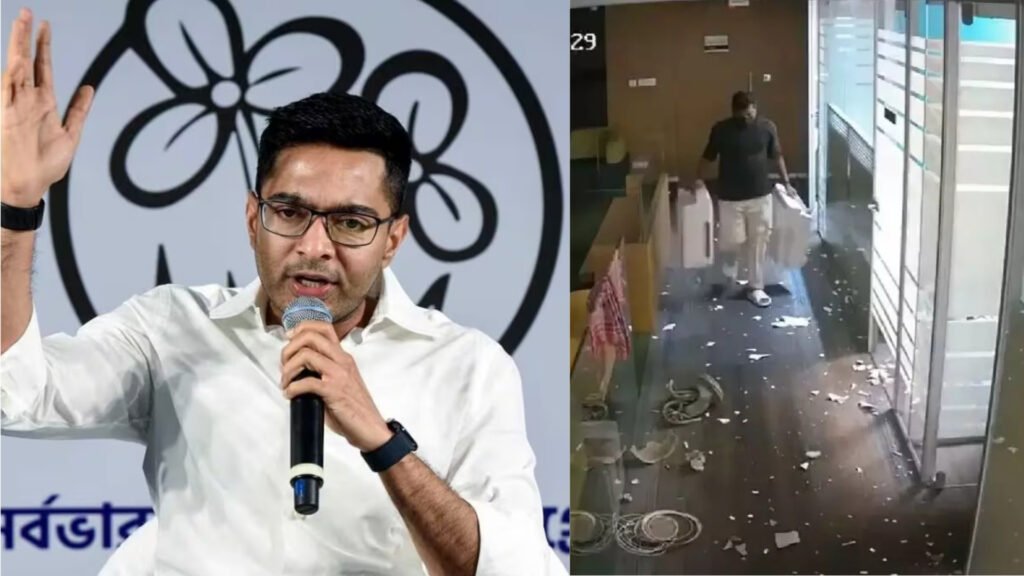
The Trinamool Congress (TMC) office on Camac Street in Kolkata was attacked and vandalized by armed men at around 4:30 a.m. on Thursday, September 3, 2026. The incident has heated up the political atmosphere in West Bengal. TMC MP and National General Secretary Abhishek Banerjee has made serious allegations that Bharatiya Janata Party (BJP) workers were behind the attack. Banerjee also shared CCTV footage on his social media account (X), showing masked men vandalizing the office and taking away electronic items. He released the CCTV footage and stated that the attackers arrived around 4:30 a.m. on Thursday. He further claimed that the armed attackers assaulted employees, snatched phones, broke furniture, scattered items throughout the office, and damaged electronic equipment. TMC leaders alleged that TMC employees and lawyers informed the police via phone and email at the time of the incident and for approximately two hours, but no action was taken for approximately two hours. Abhishek Banerjee wrote on his social media account (X) that we demand the immediate arrest of everyone involved in this attack. We also demand an investigation into who planned, organized, and directed this violence, and why the police failed to take action despite repeated information. No political party or group of armed goons can be above the law. If people can enter a political party office with weapons at 4:30 in the morning, attack people, and vandalize property, even when the police are not present, what is the rule of law left in West Bengal? Enough is enough. Arrest the culprits. Fix accountability. Take action now. He further wrote that this is what the BJP did to my party office early this morning. Will the Governor of West Bengal take action? Will the Union Home Minister take action? Will the PMO take action? Or will they simply continue to ignore it? It’s time for the judiciary, especially the Calcutta High Court, to take serious cognizance of this situation and take steps to maintain the rule of law in West Bengal. And a direct question to Suvendu Adhikari: Why are you so afraid of the Trinamool Congress and me that you have to resort to such intimidation tactics? BJP responds strongly to allegations The Bharatiya Janata Party (BJP) has strongly retorted to the allegations of vandalism at the Trinamool Congress (TMC) office, calling it a “staged drama” by the TMC. BJP MLA Sajal Ghosh said that the entire incident was staged by the TMC itself. He added that the BJP had no involvement in the incident. The TMC currently has no political issues left, so they are only doing this to remain in the limelight. BJP leaders have also questioned the timing of the incident. Sajal Ghosh asked, “What were TMC workers doing in that office so early in the morning (at 4:30 am)?” Kolkata Police have launched an investigation into the matter and detained six people from the scene. CCTV footage is also being examined.
Uttarakhand CM Announces ₹31 Crore Development Funding, Brings DA Relief for Pensioners
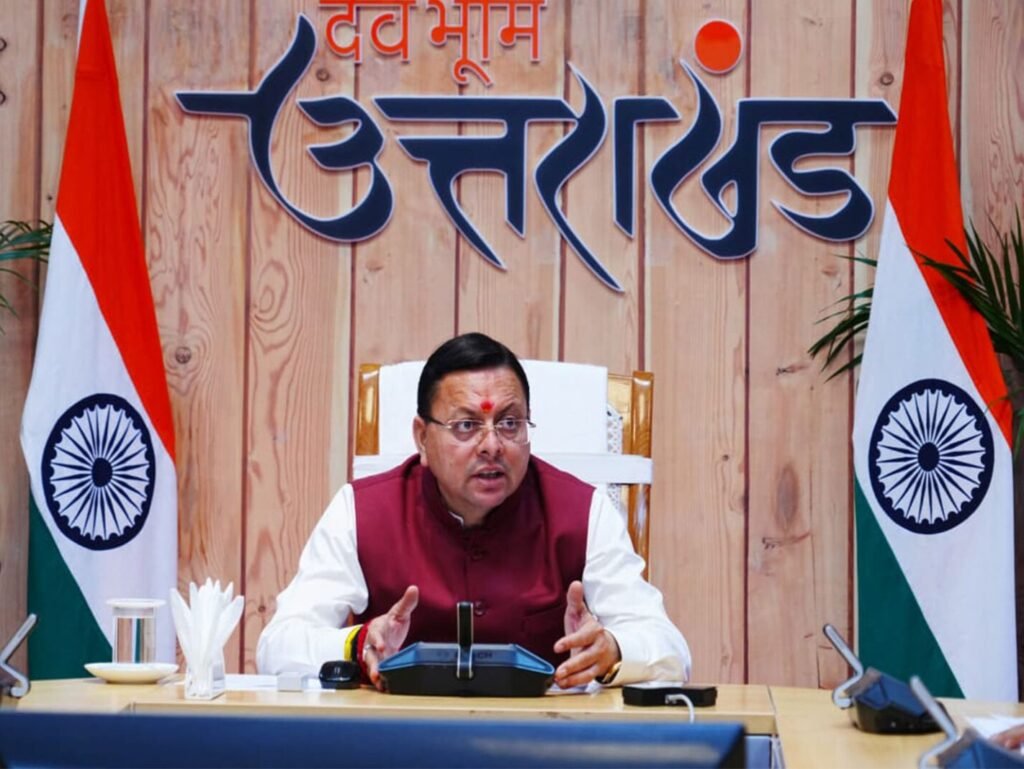
Uttarakhand Chief Minister Pushkar Singh Dhami has approved financial sanctions of around ₹31 crore for various development and construction projects across the state. The approved works include road and bridge construction, interlocking tile work and a multi-level parking facility. The government has also approved an increase in dearness allowance for pensioners of public bodies receiving pensions under the Sixth Central Pay Commission. Major Development Projects Approved One of the biggest approvals is ₹15.30 crore for the Chandak-Bans-Aanwala Ghat-Gangolihat road and the construction of a steel girder bridge over the Ramganga River in Gangolihat, Pithoragarh. In Khatima, Udham Singh Nagar, ₹3.05 crore has been sanctioned for interlocking tile work on the route from Melaghat through Baghgha Colony to Mayur Vihar. The project is expected to improve road conditions and local connectivity. ₹3.16 Crore Approved for Bridge in Rishikesh The Chief Minister has also approved ₹3.16 crore for the construction of a 30-metre-span bridge over Bangla Nala in Ward No. 3 of Bhuttowala Gram Sabha in Rishikesh. The new bridge is expected to provide better connectivity for local residents. Multi-Level Parking Facility in Champawat For the construction of a multi-level parking facility at Dechmar in Champawat, the government has sanctioned ₹9.80 crore. Uttarakhand Peyjal Nigam has been designated as the executing agency for the project. SDRF Personnel to Receive Awards The government has also approved ₹5 lakh for awards to 108 SDRF personnel for their contribution to the successful conduct of the Kumbh Mela 2025. The recognition is aimed at acknowledging the efforts of SDRF personnel during the major religious event. Public Body Pensioners to Get Higher Dearness Allowance In another decision, CM Dhami has approved an increase in Dearness Allowance (DA) for civil and family pensioners of public bodies who are receiving pensions under the Sixth Central Pay Commission. Under the approved decision, pensioners will receive 252% DA from January 1, 2025, which will increase to 257% from July 1, 2025. The rate will further rise to 262% per month from January 1, 2026. The decisions are expected to provide financial relief to eligible pensioners while also giving a push to infrastructure and development works in different parts of Uttarakhand.
BJP Announces New Spokespersons, Ravindra Jugran and Shadab Shams Among Appointees
The Bharatiya Janata Party (BJP) has expanded its team of state spokespersons in Uttarakhand, giving new responsibilities to eight party leaders. Ravindra Jugran and Shadab Shams are among the prominent names included in the expanded team. Eight Leaders Appointed as State Spokespersons The appointments were made with the approval of Uttarakhand BJP state president Mahendra Bhatt. Along with Jugran and Shams, Rajesh Shukla, Suresh Tiwari, Anukriti Gusain, Vishwajeet Negi, Satyaveer Chauhan and Manoj Jakmola have also been appointed as state spokespersons. The expanded team includes leaders from different parts of Uttarakhand, with the BJP aiming to strengthen its communication network and present the party’s position more effectively on political and public issues. Focus on Stronger Public Communication BJP state media in-charge Manveer Singh Chauhan said the spokesperson team has been expanded on the directions of the state president. The newly appointed leaders will be responsible for communicating the party’s policies, government initiatives and responses to political developments. The move is also being viewed as an effort to strengthen the BJP’s media outreach across the state and ensure a quicker response to issues raised by the opposition. Ravindra Jugran and Shadab Shams Get Key Responsibilities The inclusion of Ravindra Jugran and Shadab Shams gives the party’s Dehradun-based media team experienced political voices. Both leaders have been active in Uttarakhand politics and have previously remained involved in public and political issues. The new appointments are focused on organisational and media responsibilities and should not be interpreted as an indication of electoral ticket decisions. BJP Steps Up Preparations Ahead of 2027 With the 2027 Uttarakhand Assembly elections approaching, political activity in the state is expected to intensify. The BJP’s expanded spokesperson team is likely to play an important role in taking the party’s message to the public and responding to political developments. The new appointments underline the party’s focus on strengthening its communication strategy at both the state and local levels.
ABVP-NSUI Clash Erupts at COEP Pune Ahead of Rahul Gandhi’s ‘Chhatron Ki Goonj’ Event…
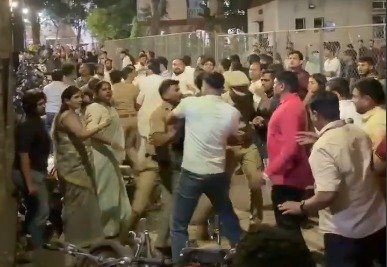
An event titled ‘Chhatron Ki Goonj’ (Students’ Voice), featuring Leader of the Opposition in the Lok Sabha, Rahul Gandhi, was scheduled for today Saturday, August 22 at the College of Engineering, Pune (COEP) in Shivajinagar. However, a commotion broke out at the venue before the event could begin. Reports indicate that a clash erupted between the Akhil Bharatiya Vidyarthi Parishad (ABVP) and the National Students’ Union of India (NSUI) at the college premises prior to the event, heating up the political atmosphere. Following the clash, both groups accused each other of assault. The dispute reportedly stemmed from the filming of a female student at COEP. The ABVP alleged that NSUI members pressured the student, while the NSUI claimed that ABVP members held her captive; this led to a confrontation between the two factions. Tension prevailed on the COEP campus for some time due to the incident. Upon being informed of the dispute, the police arrived at the scene, brought the situation under control, and initiated an investigation. Rahul Gandhi is visiting Pune today for the ‘Chhatron Ki Goonj’ event. Subsequently, several leaders—including Congress leader and Leader of the Opposition in the Legislative Assembly, Vijay Wadettiwar arrived at the site and staged a sit-in protest, while the BJP Yuva Morcha blocked the road in protest. According to the news agency PTI, a heavy police force was deployed on the campus following the dispute. Reports also suggest that some Congress workers sustained injuries. A case has been registered at the Shivajinagar police station against 50 to 60 individuals, including key office-bearers of the Youth Congress. State Congress President Harshvardhan Sapkal accused the ABVP of holding students captive in the hostel because they had posted status updates supporting Rahul Gandhi on social media. Sapkal alleged that the ABVP engaged in hooliganism, which included assaulting students and confining them to their rooms in the hostel, describing the actions as extremely serious and shameful. They questioned who gave ABVP goons the right to intimidate students and violate their freedom simply because they had posted a status featuring Rahul Gandhi. They stated that this incident once again exposes the culture of the BJP’s student politics, questioned whether these ABVP goons enjoy state protection, and declared that the Congress party would never bow to such hooliganism that attacks students’ freedom of expression and the liberty of young women.
CM Yogi Attacks Congress, Says 1947 Partition Was Proof of Cowardice
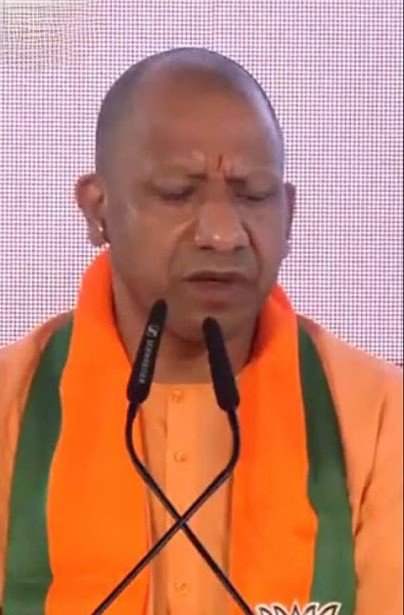
CM Yogi Adityanath said that if India had leadership like Prime Minister Narendra Modi in 1947, the country would never have been partitioned and the mass killings of millions of people could have been avoided. Uttar Pradesh Chief Minister Yogi Adityanath has launched a sharp attack on the Congress over the Partition of India in 1947, accusing the party’s leadership of putting political interests ahead of the country. Yogi said the 1947 Partition was the result of Congress’ “cowardice and lust for power” and claimed that a stronger political leadership could have prevented the division of the country. Yogi Praises PM Modi’s Leadership The Uttar Pradesh Chief Minister also compared the situation in 1947 with the present political leadership. He said that if Prime Minister Narendra Modi had been leading the country at that time, “no one could have harmed India.” Yogi was speaking during his political campaign in Maharashtra, where he also criticised Congress for what he described as following a “divide and rule” approach similar to the British. Congress Accused of Putting Power First Yogi alleged that Congress repeatedly prioritised political gains over national interests. He said the Partition resulted in widespread violence and the loss of many lives. He also accused the party of continuing to follow divisive politics and contrasted it with what he described as the BJP-led government’s focus on national unity. Remarks Come Amid Political Debate Over Partition Yogi’s comments come amid renewed political discussions around the legacy of the 1947 Partition. His remarks have added to the ongoing debate between the BJP and Congress over the political decisions and leadership that shaped India’s independence and Partition.
NDA MPs Protest Opposition Deadlock; Priyanka Gandhi, BJP Face Off Over Jharkhand Student Lathicharge…
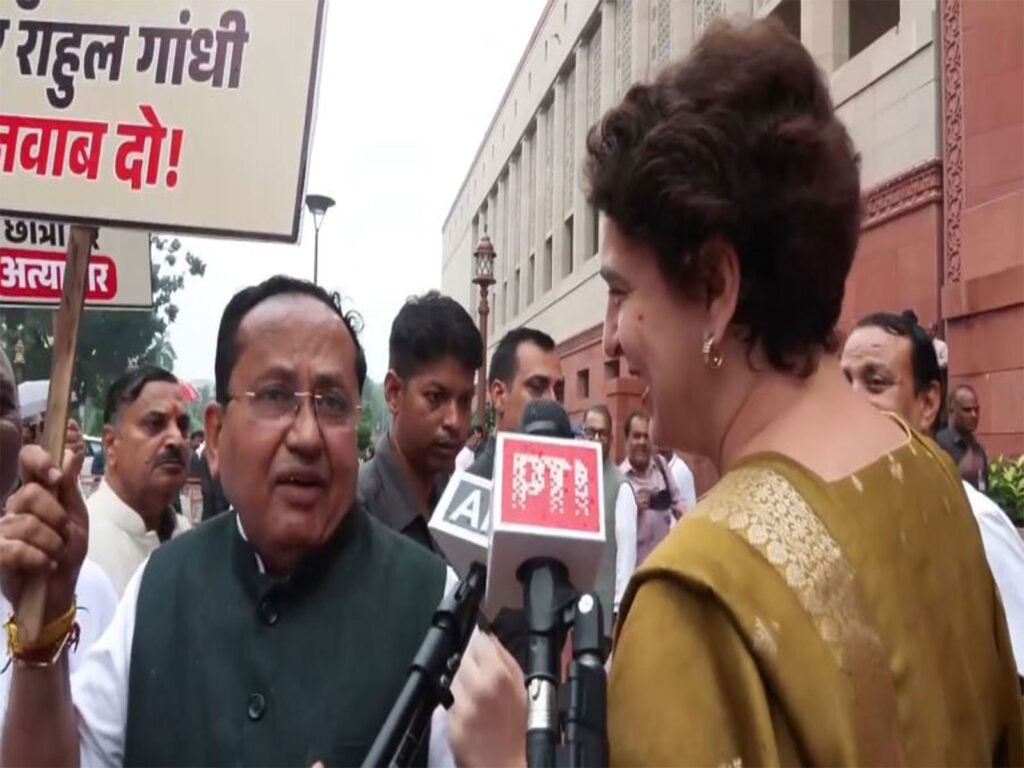
Today is the 17th day of the Monsoon Session, which began on July 20th, and not a single day has the House proceedings been smooth. Meanwhile, the opposition continues to create ruckus and raise slogans both inside and outside Parliament. On Tuesday, July 11th, National Democratic Alliance (NDA) MPs marched to Parliament to protest the opposition’s deadlock in both Houses of Parliament. This is due to the ongoing confrontation between the government and the opposition over the recent student protests and police action against the protesters. Parliament proceedings have been repeatedly disrupted due to this issue. The opposition is continuously demanding answers from the government. The government has now proposed a debate on this issue, and the Home Minister will respond. Meanwhile, on Monday, NDA MPs also demanded answers from Congress MPs regarding the lathicharge and use of water cannons by Jharkhand Police against protesting candidates taking the JPSC and JSSC exams. BJP MP and Congress MP faced off BJP MP Mukesh Dalal and Congress MP Priyanka Gandhi Vadra from Wayanad, Kerala, faced off. As Priyanka was heading to Parliament, Dalal shouted “Shame on Rahul Gandhi, shame on you!” He also held posters reading “Rahul Gandhi, answer for the brutality against students in Jharkhand.” The BJP MP asked Priyanka Gandhi when Rahul Gandhi would visit Jharkhand. Priyanka replied that she had met and interacted with the children of Jharkhand. With that, she moved on. Priyanka Gandhi also took a jab at the protests by NDA MPs, saying, “This is the first time I’ve seen MPs from the ruling party protesting. At least we forced them to do so.” Rajya Sabha member Tarun Chugh accused Gandhi of adopting double standards. He said, “This is a case of double standards. Rahul Gandhi is running away from the House and remaining silent on the lathicharge on students in Jharkhand. The country is watching.” BJP MP Sakshi Maharaj said that the entire opposition does not want any kind of discussion. As far as the issue related to students is concerned, they have one policy for Jantar Mantar and a completely different policy for Jharkhand. BJP MP Sanjay Jaiswal said that we are ready for discussion, but Rahul Gandhi is not. He has stalled the proceedings of the Lok Sabha. The Home Minister is ready to answer. BJP MP Manoj Tiwari said that Amit Shah will answer, Rahul Gandhi should not run away, Rahul Gandhi should be ashamed, so much brutality has been done to the students in Jharkhand. NCPI MP Rachna Banerjee said that everyone is demanding answers from them (the opposition). They will have to answer.