
Vijay’s Political Blockbuster, TVK Surges Past 100 Seats
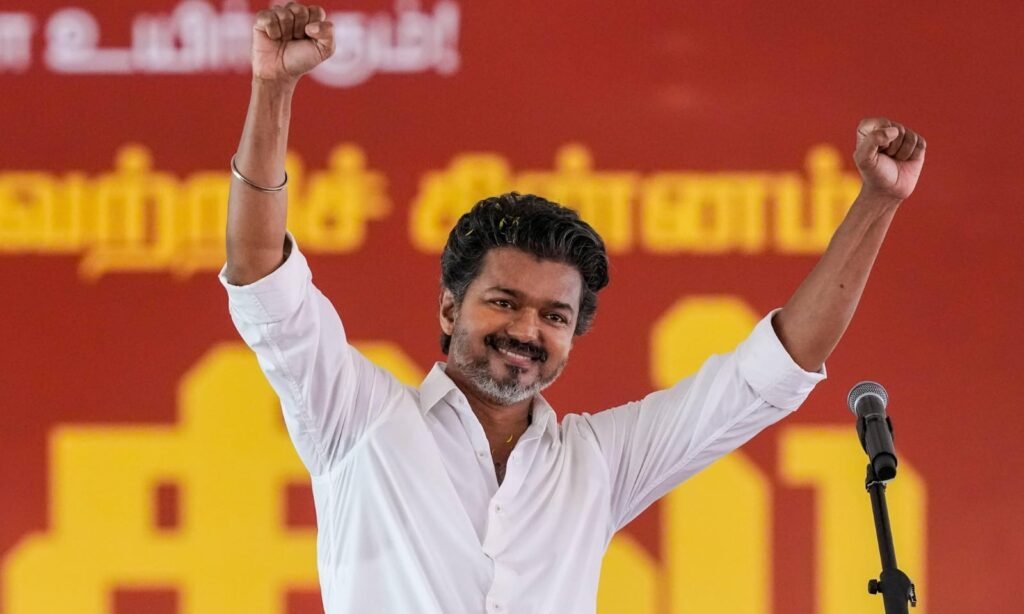
The results of the 2026 Tamil Nadu Assembly Elections have surprised everyone. Polls are being announced today for Tamil Nadu’s 234 assembly seats. Actor Vijay Thalapathy, who emerged as the biggest face of the assembly elections, has surprised the Dravidian parties in the state. Vijay’s party, the Tamilaga Vettri Kazhagam (TVK), is rapidly moving towards victory. So far, in the vote count, Vijay’s party, TVK, has surpassed 107, becoming the largest party. However, the counting of votes is still ongoing. The election results for the two-year-old political party have placed it in the league of legendary actor-turned-politicians like N.T. Rama Rao, M.G. Ramachandran, and Jayalalithaa. TVK’s victory marks a historic turning point and marks the beginning of a new political era, as for the first time since June 1977, a government can be formed in Tamil Nadu without the dominance of the DMK and AIADMK. With this, he has proven that a screen hero can also run a state. These election results prove that he has earned not only money but also the love of the people in his 33-year film career, which has already translated into votes for him in the election. It can be said that the public has loved Thalapathy not only on screen but also on the ground. After the trends emerged, there was tremendous support for Vijay. Meanwhile, celebrations prevailed at Vijay’s home. The family celebrated the party’s impressive performance by singing “Whistle Podu.” Workers outside the party headquarters in Chennai also celebrated with great enthusiasm as the latest trends showed his party emerging as the largest party in the Tamil Nadu Assembly elections. A large number of excited workers and supporters gathered outside the party office, waving flags and distributing sweets to celebrate the party’s success. TVK National Spokesperson Felix Gerald said, “You will see that there will be no need for any alliance. I can assure you that we will form the government on our own. There are no ifs and buts. This is a very clear mandate.” The message is clear: the public has put an end to the politics of loot, corruption and nepotism. This is the end of dynasty politics, this is the end of the DMK.
After Voting, Chaos: EVM Controversy Heats Up Bengal Politics
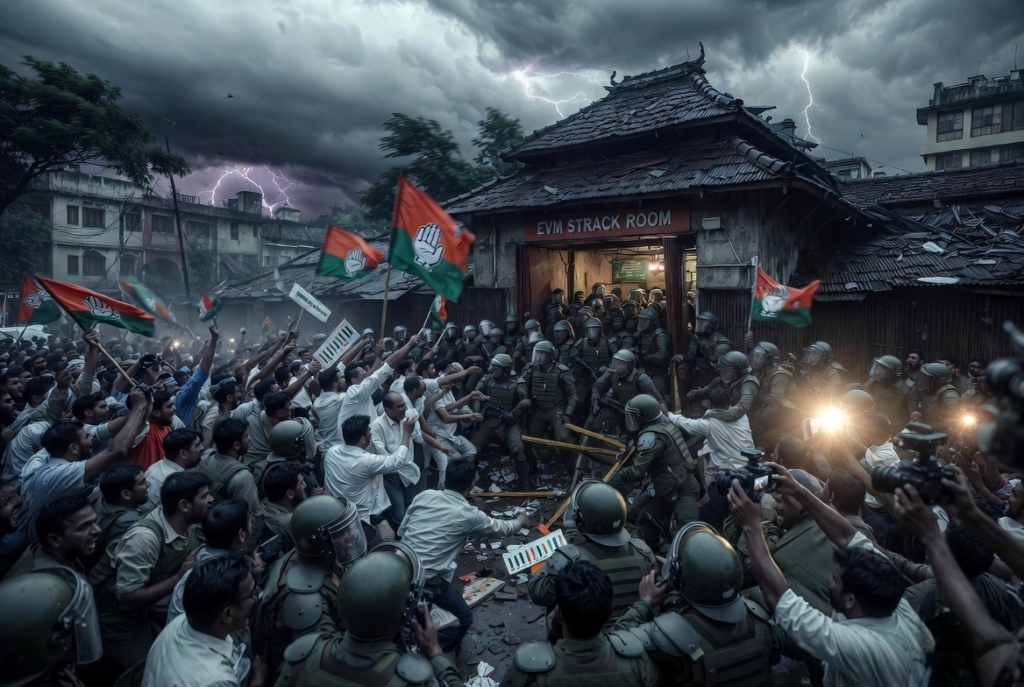
Election-related tensions in West Bengal have escalated beyond the usual patterns of political friction, drawing sharp reactions from parties and observers alike. The ongoing developments have created an atmosphere of uncertainty even after polling in key phases has concluded. On Thursday, workers and leaders of the Bharatiya Janata Party (BJP) and the All India Trinamool Congress (TMC) clashed at multiple locations across the state. Reports indicate heated exchanges between political representatives and local authorities, alongside protests over alleged irregularities in the handling and storage of Electronic Voting Machines (EVMs) in designated strong rooms. In a significant and rare move, Chief Minister Mamata Banerjee visited the strong room at Bhabanipur in Kolkata. Her presence at the site during this sensitive stage of the electoral process has intensified political debate, with opposition parties questioning the intent while TMC leaders defended the move as a step to ensure transparency. The controversy surrounding EVM security, which began on Thursday evening, continued into Friday. The TMC accused the Election Commission of India of acting in a biased manner and favoring the opposition. Escalating the matter legally, the party approached the Supreme Court of India, challenging a decision taken by the Chief Electoral Officer. West Bengal had recorded polling for 142 assembly constituencies in the second phase on April 29. The counting of votes is scheduled for May 4. Traditionally, the intensity of political confrontations subsides after voting concludes, but the current scenario suggests otherwise, with tensions persisting across districts. Political analysts point out that several unprecedented incidents have marked the 2026 Assembly elections in the state. While the BJP and TMC remain locked in a direct confrontation, experts themselves are divided over the fairness and management of the electoral process, reflecting the deeply polarized nature of West Bengal’s political landscape.
EVM Controversy Sparks Security Clampdown in Kolkata Ahead of Results
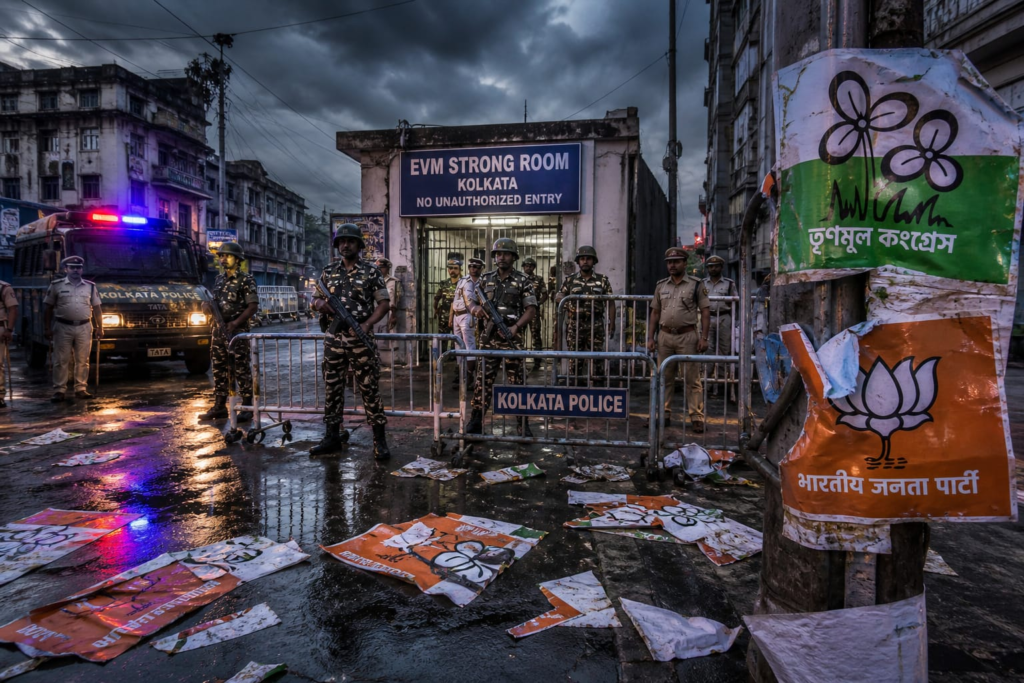
Following a high-voltage controversy over alleged EVM tampering in Kolkata ahead of vote counting, authorities have tightened security and imposed strict restrictions. After Trinamool Congress (TMC) raised concerns about “suspicious activities,” police banned all forms of public gatherings in seven sensitive locations across the city. The restrictions have been enforced in areas including Sahid Khudiram Bose Road, Judge’s Court Road, Jadavpur, Diamond Harbour Road, Lord Sinha Hall, Naresh Mitra Sarani (Beltala Road), and Pramathesh Barua Sarani. Security has also been significantly strengthened around strong rooms where EVMs are stored, as well as at counting centres. At Khudiram Anushilan Kendra, which houses EVMs from several constituencies in north and east Kolkata, additional central forces and armed police personnel have been deployed. Officials stated that the entire area is under close supervision of senior officers. Meanwhile, tensions escalated outside Netaji Indoor Stadium, where workers of the Bharatiya Janata Party (BJP) and TMC engaged in sloganeering and a brief clash. TMC leaders Kunal Ghosh and Shashi Panja staged a protest at the site. Amid the situation, Chief Minister Mamata Banerjee visited the Shakhawat Memorial counting centre and remained there for some time. However, West Bengal Chief Electoral Officer Manoj Kumar Agarwal dismissed the allegations, stating that all strong rooms were sealed properly after polling in the presence of candidates and officials. He clarified that postal ballots were being sorted using torchlight due to the absence of electricity inside strong rooms—a standard protocol—which was misinterpreted as suspicious activity. According to him, the entire process remains secure and transparent, with all stakeholders kept informed.
West Bengal Row Over Centre’s Deployment of “Encounter Specialist” IPS Officer…
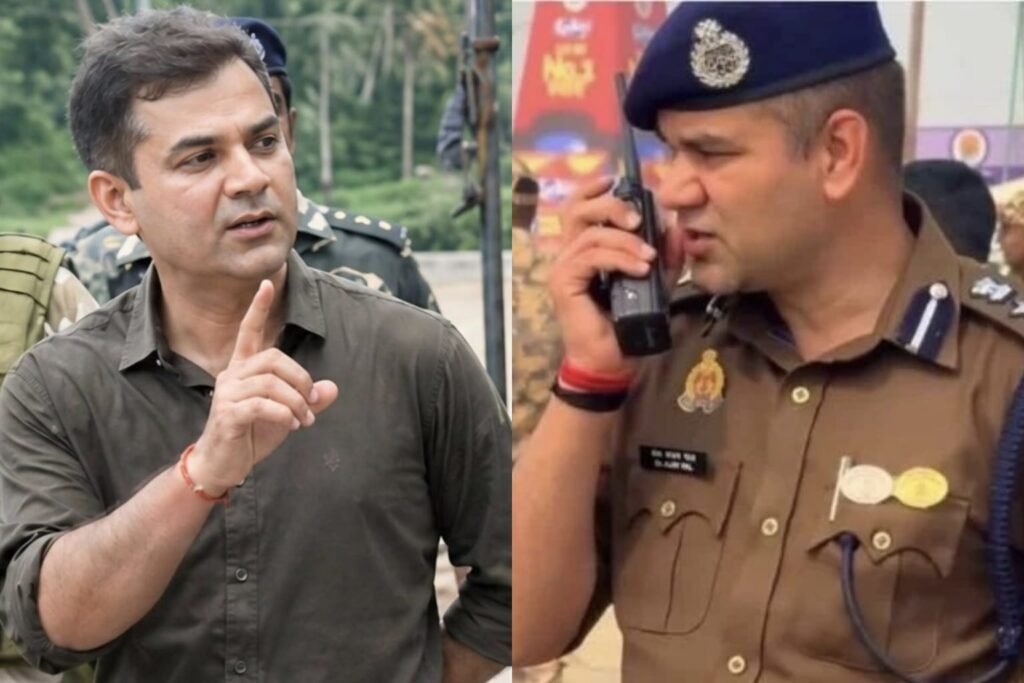
The deployment of an IPS officer Ajay Pal Sharma known as an “encounter specialist” to a key Lok Sabha constituency in West Bengal has triggered a sharp political row. The transfer, carried out by the central government, comes ahead of the 2026 West Bengal Legislative Assembly elections and has been interpreted by opposition parties as a politically motivated step rather than a neutral administrative decision. TMC Accuses Centre of Overreach The ruling All India Trinamool Congress (TMC) has accused the Centre of interfering in West Bengal’s internal affairs. Party leaders argue that law and order is a state subject and that the posting of a high‑profile officer from outside the state smacks of political overreach. TMC leaders have described the move as an attempt to “plant” central agents into the state’s administrative setup, particularly in a politically sensitive area. Chief Minister Mamata Banerjee has called the transfer part of a “grand conspiracy” and warned that her government will not bow to pressure from New Delhi. The party is using the controversy to galvanise public sentiment around the idea that an opposition‑ruled state is being targeted by the Centre on the eve of elections. Akhilesh Yadav Voices Concerns Samajwadi Party national president Akhilesh Yadav has supported the TMC’s stance, warning that such actions could create an atmosphere of intimidation in non‑BJP states. He has framed the deployment as a political act aimed at tilting the playing field in favour of the ruling party, rather than a genuine security measure. Akhilesh has also stressed the importance of federal balance, arguing that the autonomy of states should not be undermined under the cover of administrative or law‑and‑order decisions. His remarks have given the West Bengal episode a broader national resonance, linking it to wider concerns about Centre‑state relations. BJP Defends Move as Administrative Necessity The Bharatiya Janata Party (BJP) has rejected the allegations, insisting that the officer’s posting is a routine administrative step to strengthen law enforcement. Party leaders maintain that experienced IPS officers, including those with a strong record in tackling crime, should be allowed to serve where the Centre deems them most effective. According to the BJP, attempts to politicise the transfer are an effort to divert attention from governance issues. The party is emphasising a narrative of “strong and decisive” leadership, arguing that robust policing and the deployment of seasoned officers are necessary to ensure public order and security. Growing Clash Amid Election Preparations The controversy is unfolding as political activity in West Bengal heats up for the upcoming assembly polls. Both the TMC and the BJP are using the issue to frame their electoral narratives: the TMC focuses on alleged interference and pressure from the Centre, while the BJP highlights tough security measures and efficient governance. Observers note that such Centre‑state confrontations over postings, inquiries, and enforcement actions have become more pronounced in recent years, especially in non‑BJP states. The treatment of the “encounter specialist” episode in West Bengal is likely to influence not only local voter sentiment but also the wider national debate on the balance between security‑driven decisions and political intent.