
After Voting, Chaos: EVM Controversy Heats Up Bengal Politics
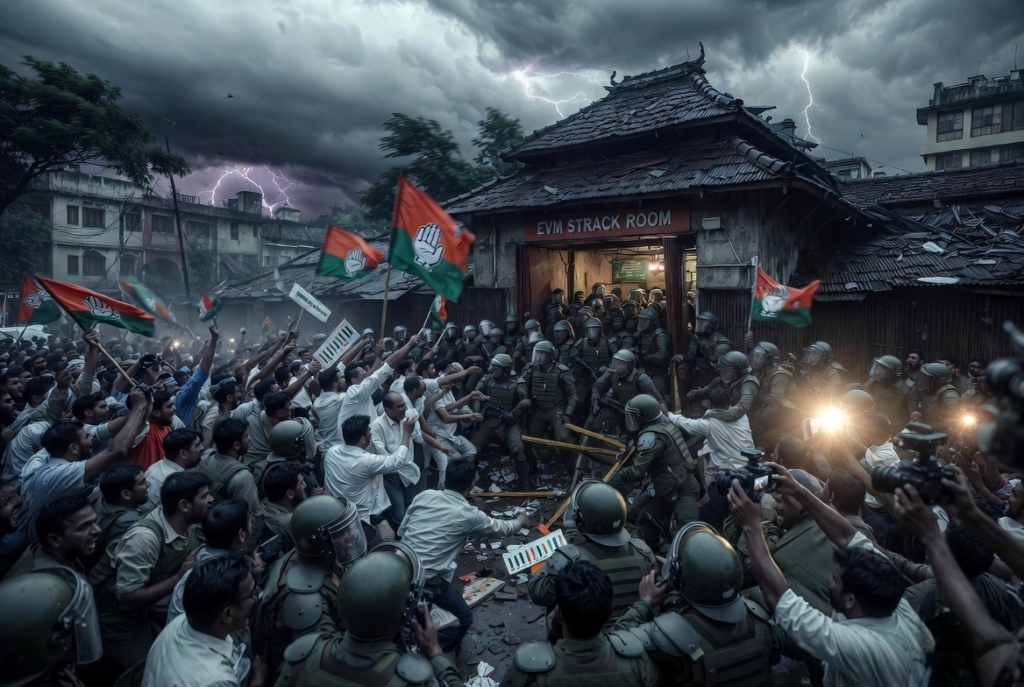
Election-related tensions in West Bengal have escalated beyond the usual patterns of political friction, drawing sharp reactions from parties and observers alike. The ongoing developments have created an atmosphere of uncertainty even after polling in key phases has concluded. On Thursday, workers and leaders of the Bharatiya Janata Party (BJP) and the All India Trinamool Congress (TMC) clashed at multiple locations across the state. Reports indicate heated exchanges between political representatives and local authorities, alongside protests over alleged irregularities in the handling and storage of Electronic Voting Machines (EVMs) in designated strong rooms. In a significant and rare move, Chief Minister Mamata Banerjee visited the strong room at Bhabanipur in Kolkata. Her presence at the site during this sensitive stage of the electoral process has intensified political debate, with opposition parties questioning the intent while TMC leaders defended the move as a step to ensure transparency. The controversy surrounding EVM security, which began on Thursday evening, continued into Friday. The TMC accused the Election Commission of India of acting in a biased manner and favoring the opposition. Escalating the matter legally, the party approached the Supreme Court of India, challenging a decision taken by the Chief Electoral Officer. West Bengal had recorded polling for 142 assembly constituencies in the second phase on April 29. The counting of votes is scheduled for May 4. Traditionally, the intensity of political confrontations subsides after voting concludes, but the current scenario suggests otherwise, with tensions persisting across districts. Political analysts point out that several unprecedented incidents have marked the 2026 Assembly elections in the state. While the BJP and TMC remain locked in a direct confrontation, experts themselves are divided over the fairness and management of the electoral process, reflecting the deeply polarized nature of West Bengal’s political landscape.
EVM Controversy Sparks Security Clampdown in Kolkata Ahead of Results
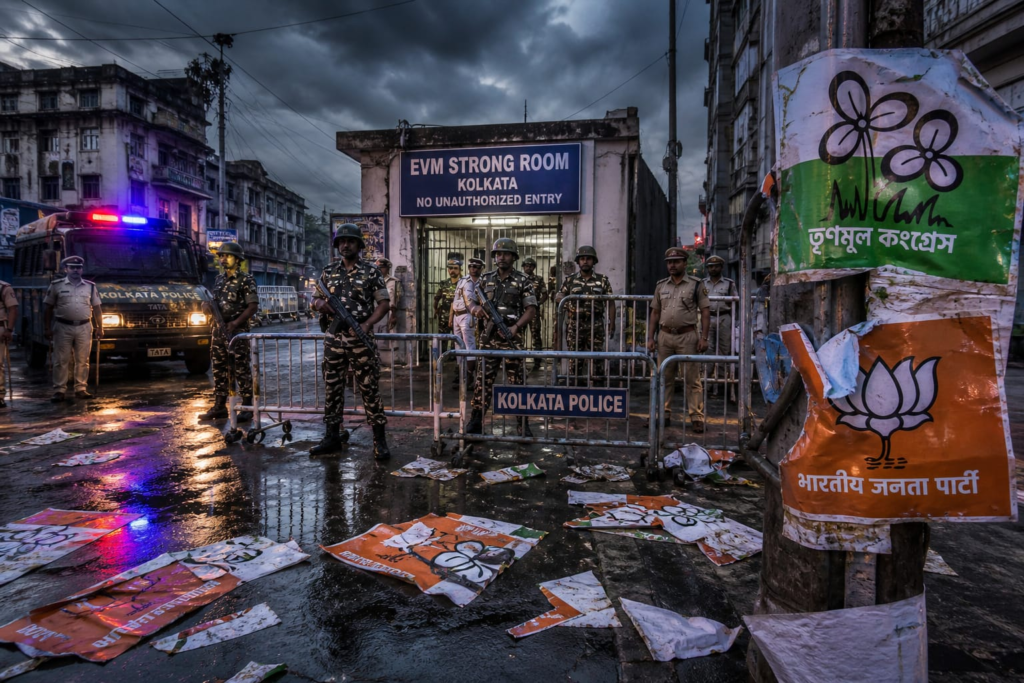
Following a high-voltage controversy over alleged EVM tampering in Kolkata ahead of vote counting, authorities have tightened security and imposed strict restrictions. After Trinamool Congress (TMC) raised concerns about “suspicious activities,” police banned all forms of public gatherings in seven sensitive locations across the city. The restrictions have been enforced in areas including Sahid Khudiram Bose Road, Judge’s Court Road, Jadavpur, Diamond Harbour Road, Lord Sinha Hall, Naresh Mitra Sarani (Beltala Road), and Pramathesh Barua Sarani. Security has also been significantly strengthened around strong rooms where EVMs are stored, as well as at counting centres. At Khudiram Anushilan Kendra, which houses EVMs from several constituencies in north and east Kolkata, additional central forces and armed police personnel have been deployed. Officials stated that the entire area is under close supervision of senior officers. Meanwhile, tensions escalated outside Netaji Indoor Stadium, where workers of the Bharatiya Janata Party (BJP) and TMC engaged in sloganeering and a brief clash. TMC leaders Kunal Ghosh and Shashi Panja staged a protest at the site. Amid the situation, Chief Minister Mamata Banerjee visited the Shakhawat Memorial counting centre and remained there for some time. However, West Bengal Chief Electoral Officer Manoj Kumar Agarwal dismissed the allegations, stating that all strong rooms were sealed properly after polling in the presence of candidates and officials. He clarified that postal ballots were being sorted using torchlight due to the absence of electricity inside strong rooms—a standard protocol—which was misinterpreted as suspicious activity. According to him, the entire process remains secure and transparent, with all stakeholders kept informed.