
Middle East on Edge, Drone Strike Near UAE Nuclear Plant Sparks Global Alarm
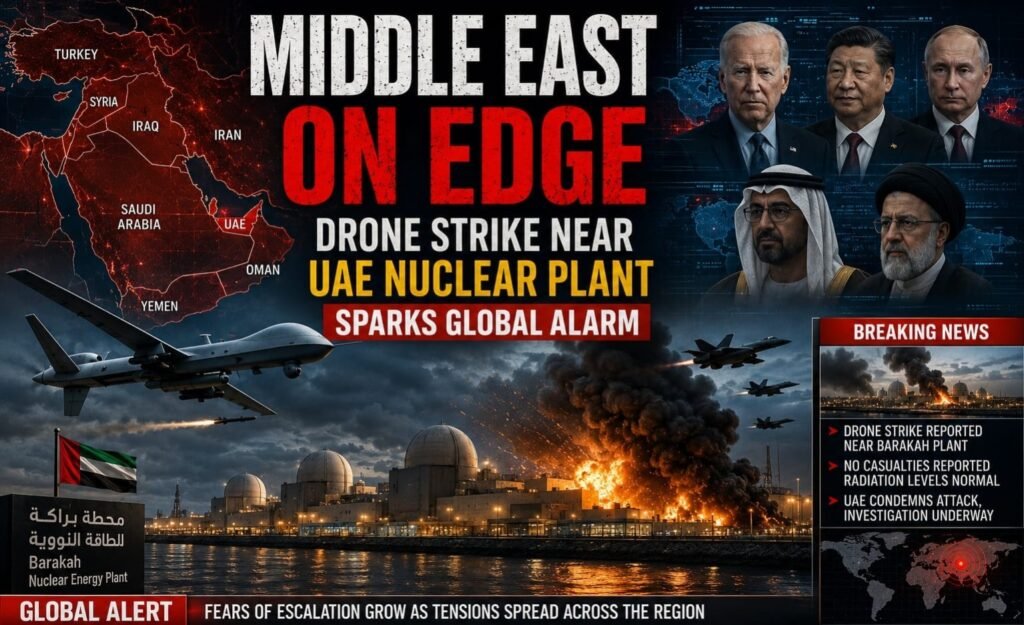
Tensions in the Middle East appear to be reaching a dangerous level after a drone attack and fire incident near the UAE’s Barakah Nuclear Energy Plant raised concerns across the Gulf region. At the same time, US President Donald Trump issued a strong warning to Iran, saying that time is running out for a peace agreement with Washington. After returning from China, Trump also held a high-level meeting with security officials. The attack came at a time when efforts by the United States and Israel to ease tensions with Iran had stalled, increasing fears over regional security in the Gulf. The UAE has not blamed any country for the attack so far. According to the UAE Defence Ministry, investigations are currently underway. Officials stated that air defence systems intercepted two drones mid-air, while a third drone struck a power generator located near the nuclear plant. The ministry added that the drone approached from the western border, though no further details have been released. According to Abu Dhabi media reports, the drone targeted a power generator situated outside the plant’s secure internal zone. The International Atomic Energy Agency (IAEA) said the attack triggered a fire near the facility, forcing the reactor to temporarily operate on emergency diesel generators.
UAE Exit Weakens OPEC as Oil Markets Face New Uncertainty
The Organization of the Petroleum Exporting Countries (OPEC) is set to feel structurally weaker without the United Arab Emirates, one of its largest and most disciplined producers, after more than five decades of membership. The UAE’s departure comes at a moment when the cartel’s influence over global oil markets has already been eroded by rising U.S. output and internal tensions among its members. Why the UAE left Analysts say the UAE wants to free itself from OPEC’s production quotas to ramp up output beyond the roughly 3–3.5 million barrels per day it was allowed under the group’s rules. As the fourth‑largest producer in OPEC, the UAE accounted for about 3 percent of global crude supply and close to 11–15 percent of OPEC capacity, so its exit diminishes the group’s spare production cushion. Regional tensions and the Strait of Hormuz The decision is also shaped by heightened friction in the Persian Gulf, including missile and drone attacks linked to Iran that have disrupted shipping through the Strait of Hormuz. That chokepoint has effectively become more constrained, raising doubts about the reliability of Gulf supplies and shifting market attention away from the UAE’s formal exit in the short term. What this means for OPEC and prices Without the UAE, OPEC’s core producing trio will largely be Saudi Arabia, Iraq, and Iran—a mix that may struggle to maintain unified policy, especially if Saudi Arabia seeks to defend its market share through price pressure. Some experts warn the move could weaken OPEC+’s ability to stabilize prices, while others note that Saudi Arabia has already been relying on alliances with Russia and other non‑OPEC producers to keep the group relevant. Long‑term uncertainty Historically, the oil market was dominated by a handful of Western majors known as the “Seven Sisters,” which later evolved into companies such as Shell, Chevron, ExxonMobil, and BP. Just as the industry adapted to that earlier shift, OPEC may adjust again—but the UAE’s exit adds new uncertainty about how much real control the cartel will retain over global oil flows in the coming years.