PM Modi Completes 25 Years of Continuous Governance; Nationwide ‘Seva Sankalp Abhiyan’ to Be Launched from Sept 17–Oct 17…
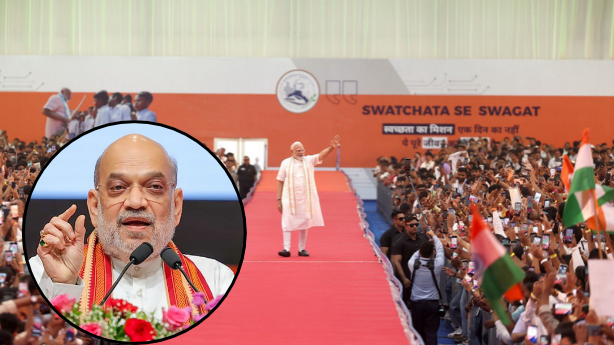
Prime Minister Narendra Modi is completing 25 years of governance and public service. Consequently, the ‘Seva Sankalp Abhiyan’ will be launched across the country from September 17 to October 17, 2026. Union Home Minister Amit Shah made this announcement during a press conference in Mumbai on Sunday, September 13, to mark the completion of 25 years of Prime Minister Narendra Modi’s public life (as Chief Minister of Gujarat and Prime Minister of the country). Amit Shah Says PM Modi Transformed India’s Governance From Paralysis to Action Amit Shah said that upon assuming the reins of the country in 2014, Prime Minister Narendra Modi declared himself the ‘Pradhan Sevak’ from the Red Fort. He never considered himself a ruler, but always worked as a servant of the people. Addressing a press conference, Union Home Minister Amit Shah stated that Prime Minister Narendra Modi has transformed India from a state of “policy paralysis” and weak decision-making to a culture of decisive governance and action. He emphasized that before 2014, the country’s governance system was plagued by coalition constraints and indecisive mistakes, which PM Modi’s strong leadership has completely transformed. During the conference, Amit Shah announced that with the support of the Bharatiya Janata Party, its allies, the entire NDA family, various organizations, and the people of the country, a nationwide “Seva Sankalp Abhiyan” will be launched from September 17 to October 17, 2026. This campaign is being organized to mark Prime Minister Narendra Modi’s 25 years in public life. Amit Shah noted that September 17 is Prime Minister Narendra Modi’s birthday. The BJP has been celebrating his birthday as “Seva Saptah” (Service Week), first in Gujarat and later across the country, from September 17 to October 2. However, this year’s campaign holds special significance, as Narendra Modi will complete 25 consecutive years as Chief Minister and Prime Minister on October 7, 2026. He said that there are very few leaders in the country who have achieved such a long record of continuous public service both as Chief Minister of a state and Prime Minister of the country. The Home Minister stated that the Seva Sankalp Abhiyan will be launched in every state and union territory of the country. Under this campaign, the public will be reached at every district, Lok Sabha constituency, Assembly constituency, and booth level. He said that Prime Minister Modi has always presented himself to the nation as the “Pradhan Sevak” (Chief Servant) and his entire political career has been dedicated to public service. Amit Shah said that the Modi government has used constitutional powers to ensure the welfare of the poor, build a strong economy, strengthen national security, and address long-standing problems. He said that the country is moving forward with the goal of a developed India by 2047, and Prime Minister Modi has strengthened this resolve among the people. He said that between 2014 and 2026, the country’s politics has seen a major change. Evils like corruption, casteism, and nepotism have now been replaced by performance-based politics. Shah claimed that for the first time in the last 12 years, the country has experienced a strong and clear foreign policy, in which India’s interests have been given top priority. Amit Shah said that before 2014, India was counted among the “Fragile Five” economies, but today the country is among the top five economies in the world. He said that according to the recently released first quarter data, India is at the forefront among major economies with a GDP growth rate of 7.8 percent.
NDA MPs Protest Opposition Deadlock; Priyanka Gandhi, BJP Face Off Over Jharkhand Student Lathicharge…
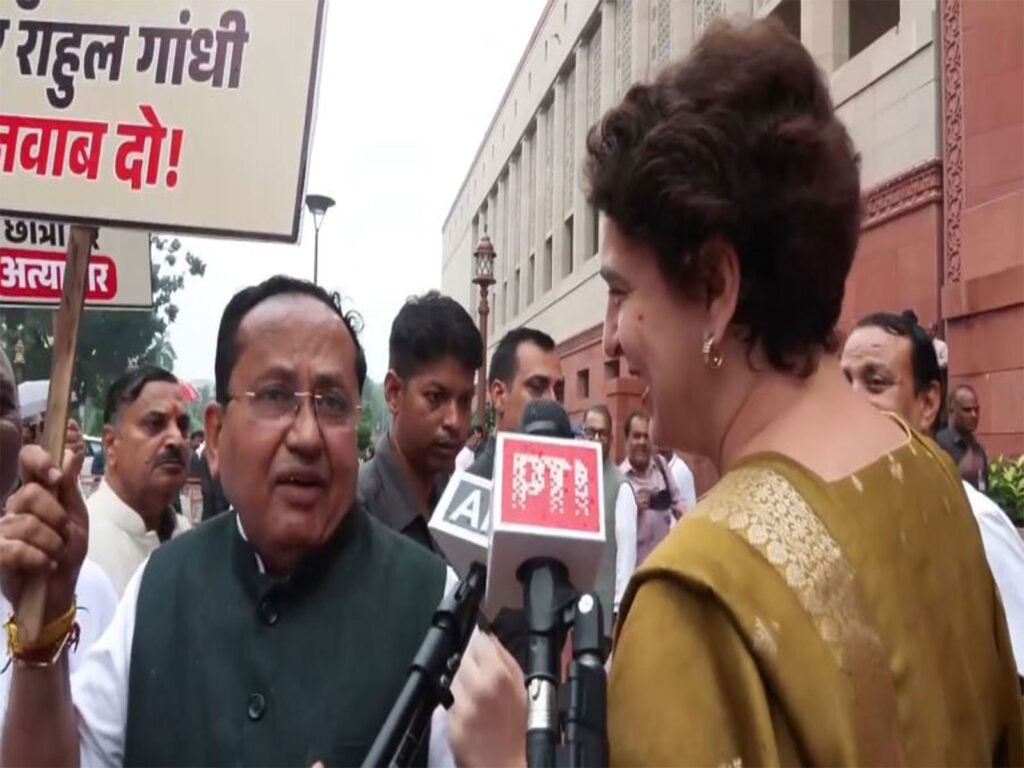
Today is the 17th day of the Monsoon Session, which began on July 20th, and not a single day has the House proceedings been smooth. Meanwhile, the opposition continues to create ruckus and raise slogans both inside and outside Parliament. On Tuesday, July 11th, National Democratic Alliance (NDA) MPs marched to Parliament to protest the opposition’s deadlock in both Houses of Parliament. This is due to the ongoing confrontation between the government and the opposition over the recent student protests and police action against the protesters. Parliament proceedings have been repeatedly disrupted due to this issue. The opposition is continuously demanding answers from the government. The government has now proposed a debate on this issue, and the Home Minister will respond. Meanwhile, on Monday, NDA MPs also demanded answers from Congress MPs regarding the lathicharge and use of water cannons by Jharkhand Police against protesting candidates taking the JPSC and JSSC exams. BJP MP and Congress MP faced off BJP MP Mukesh Dalal and Congress MP Priyanka Gandhi Vadra from Wayanad, Kerala, faced off. As Priyanka was heading to Parliament, Dalal shouted “Shame on Rahul Gandhi, shame on you!” He also held posters reading “Rahul Gandhi, answer for the brutality against students in Jharkhand.” The BJP MP asked Priyanka Gandhi when Rahul Gandhi would visit Jharkhand. Priyanka replied that she had met and interacted with the children of Jharkhand. With that, she moved on. Priyanka Gandhi also took a jab at the protests by NDA MPs, saying, “This is the first time I’ve seen MPs from the ruling party protesting. At least we forced them to do so.” Rajya Sabha member Tarun Chugh accused Gandhi of adopting double standards. He said, “This is a case of double standards. Rahul Gandhi is running away from the House and remaining silent on the lathicharge on students in Jharkhand. The country is watching.” BJP MP Sakshi Maharaj said that the entire opposition does not want any kind of discussion. As far as the issue related to students is concerned, they have one policy for Jantar Mantar and a completely different policy for Jharkhand. BJP MP Sanjay Jaiswal said that we are ready for discussion, but Rahul Gandhi is not. He has stalled the proceedings of the Lok Sabha. The Home Minister is ready to answer. BJP MP Manoj Tiwari said that Amit Shah will answer, Rahul Gandhi should not run away, Rahul Gandhi should be ashamed, so much brutality has been done to the students in Jharkhand. NCPI MP Rachna Banerjee said that everyone is demanding answers from them (the opposition). They will have to answer.
August 5, 2019 to 2026: 7 Years of Post-Article 370 Jammu and Kashmir
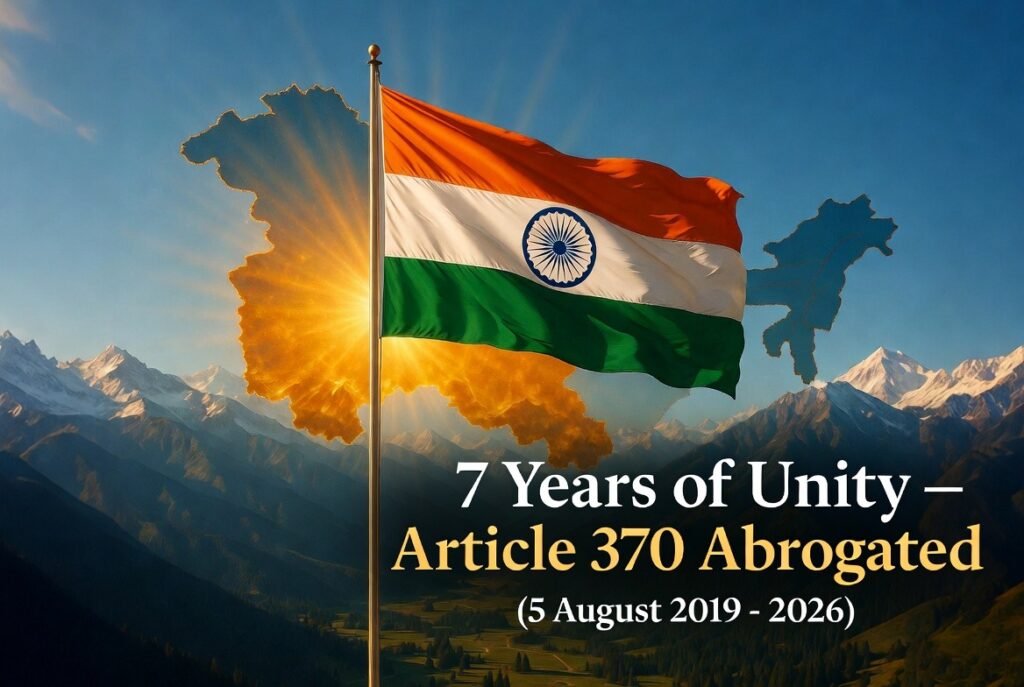
It has been seven years since the destiny of Jammu and Kashmir was transformed. It was on this very day in 2019 that Article 370 and Article 35A were abrogated in Jammu and Kashmir. This is considered the most significant achievement of the BJP government’s tenure. Just months after the NDA government began its second term under the leadership of Prime Minister Narendra Modi, Article 370 and Article 35A—which granted special status to Jammu and Kashmir—were revoked. This is regarded as one of the most secretive strategic missions in the history of Indian politics. Knowledge of the entire operation was confined to a select few—including PM Modi, Home Minister Amit Shah, and National Security Advisor Ajit Doval—and no one else got wind of it. What is Article 370? Article 370 was a temporary provision of the Constitution that granted Jammu and Kashmir a special autonomous status compared to other Indian states. This provision came into effect on October 26, 1947—shortly after India gained independence—and remained in force until August 5, 2019. Under this article, Jammu and Kashmir had its own separate constitution and flag. Except for matters concerning defense, foreign affairs, finance, and communications, the approval of the Jammu and Kashmir State Assembly was mandatory for the implementation of central laws. Furthermore, non-residents of Jammu and Kashmir could not purchase movable property, land, or houses in the region, nor were they eligible for state government jobs. Certain provisions of the Indian Constitution—such as the Right to Education (RTE) and the Right to Property—were not applicable in Jammu and Kashmir under this article. Changes after the abrogation of Article 370 With the abrogation of Article 370, the special status granted to Jammu and Kashmir came to an end. Post-2019, the Indian Constitution became fully applicable in the region. The provisions for a separate constitution and flag for Jammu and Kashmir were also abolished. Non-residents can now purchase land in Jammu and Kashmir, subject to certain conditions. Additionally, citizens of Jammu and Kashmir became eligible to apply for jobs in other states. Jammu and Kashmir was bifurcated into two Union Territories: Jammu and Kashmir, with a legislative assembly, and Ladakh, as a Union Territory without one. While incidents of stone-pelting were previously common in the region, the youth of Jammu and Kashmir began joining the Indian Army following the abrogation of Article 370. Terrorist incidents in the region also declined.