Lord Jagannath’s grand Rath Yatra 2026 begins; Bahuda Yatra to take place on July 24
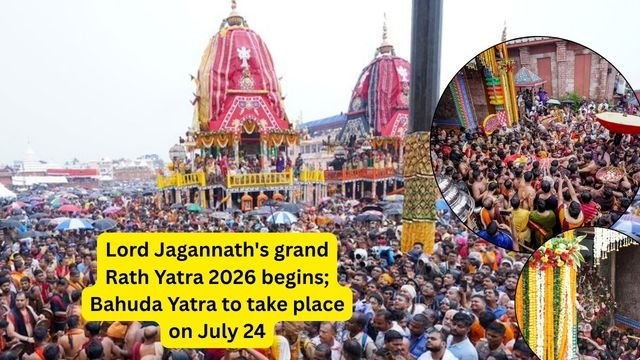
The world-famous Jagannath Yatra (procession) of Lord Jagannath has commenced for the year 2026. Beginning on July 16, 2026, the festival will conclude on July 24, 2026, with the Bahuda Yatra, or the return journey home. This festival marks the nine-day annual journey of Lord Jagannath, Balabhadra, and Devi Subhadra, during which they travel in grand wooden chariots from the main Jagannath Temple. Held in Puri, Odisha, the Jagannath Yatra is renowned across the globe. Stages Of Yatra The Yatra spans several days and includes various significant stages and rituals. One such stage involves Pahandi and Chera Pahanra; the former entails the ceremonial transfer of the deities onto their chariots, while the latter involves the Gajapati Maharaja sweeping the chariots with a golden broom. Another key stage is the Bahuda Yatra—the return journey of the deities to the main Jagannath Temple—followed by the final stages known as Suna Besha and Niladri Bije, which mark the conclusion of the nine-day observance. Importance Of Jagannath Yatra This Yatra is not merely a religious event but an immense ocean of faith, surrender, and devotion. Held annually in Puri, Odisha, on the second day (Dwitiya Tithi) of the bright fortnight (Shukla Paksha) of the Ashadha month, the Jagannath Yatra draws devotees from all over the world. Participating in the procession and pulling the chariot’s ropes holds profound spiritual and religious significance. The rope used to pull Lord Jagannath’s chariot is believed to symbolize Shankhachuda. It is also widely believed that merely touching or pulling this rope can cleanse one of all sins and lead to Moksha (salvation).
President Droupadi Murmu Turns 68: From Odisha’s Tribal Heartland to Rashtrapati Bhavan
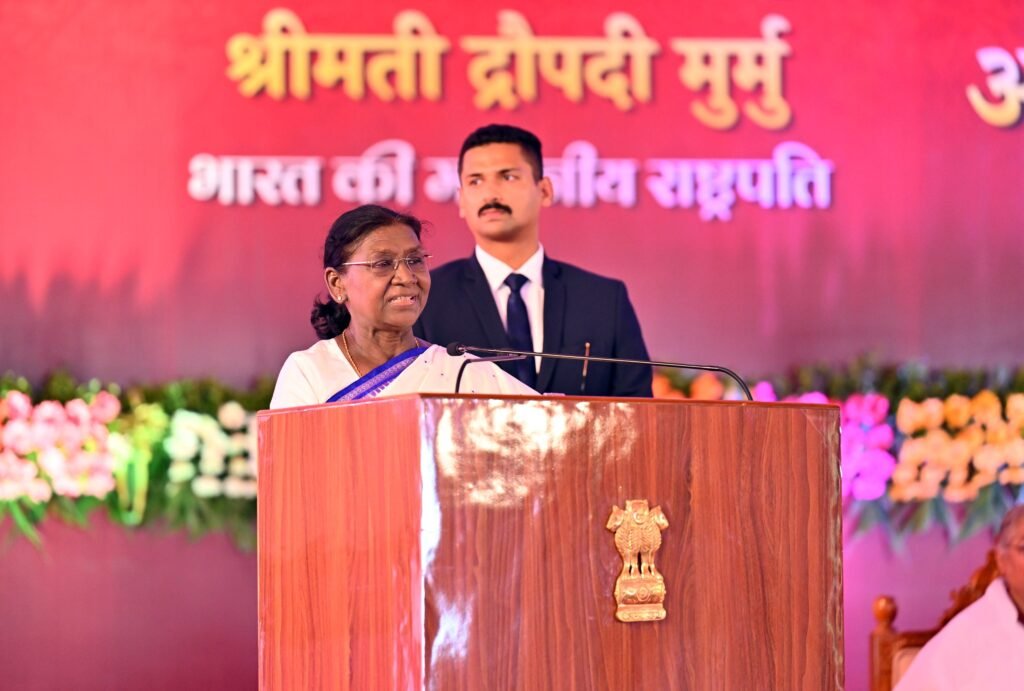
Today marks the birthday of India’s incumbent and 15th President, Droupadi Murmu. She was born on June 20, 1958, in Baidaposi village, located in the Mayurbhanj district of Odisha. Her father’s name was Biranchi Narayan Tudu. President Droupadi Murmu has also been a member of the Bharatiya Janata Party (BJP). She is the second woman to serve as the President of India, following former President Pratibha Patil. Additionally, she has been honored with the title of ‘Prabuddha Mahila Samrat’ (Enlightened Woman Empress) by the Prabuddha Samiti. President Droupadi Murmu is the second person from Odisha to hold the office of President and is the youngest President in the country’s history. Notably, she is the first President of India to have been born after the country gained independence. Prior to assuming the presidency, she served in various portfolios within the Odisha state government’s cabinet between 2000 and 2004 and also served as the 9th Governor of Jharkhand from 2015 to 2021. Both President Droupadi Murmu’s grandfather and father served as the village head (Pradhan). She was married to Shyam Charan Murmu, and they had two sons and a daughter. Tragically, her husband and both sons met with untimely deaths at different times; her daughter is married and resides in Bhubaneswar. Droupadi Murmu began her career as a teacher before gradually entering the field of politics. She embarked on her political journey in 1997 by winning the election for Councilor of the Rairangpur Nagar Panchayat. She served as the Vice President of the BJP’s Scheduled Tribes Morcha and was also a member of the National Executive of the BJP’s Tribal Morcha. She won the election twice—in 2000 and 2009—from the Rairangpur constituency in Odisha’s Mayurbhanj district on a BJP ticket, serving as a Member of the Legislative Assembly (MLA). In the coalition government formed by Naveen Patnaik’s Biju Janata Dal and the BJP in Odisha, Draupadi Murmu served as a minister—first for Commerce and Transport, and later for Fisheries and Animal Resources Development. In 2015, she became the ninth Governor of Jharkhand, succeeding Syed Ahmed; Virender Singh, the then Chief Justice of the Jharkhand High Court, administered the oath of office to her.