
TMC Camac Street Office Vandalized in Early Morning Attack; Abhishek Banerjee Blames BJP, Party Calls it Staged Drama..
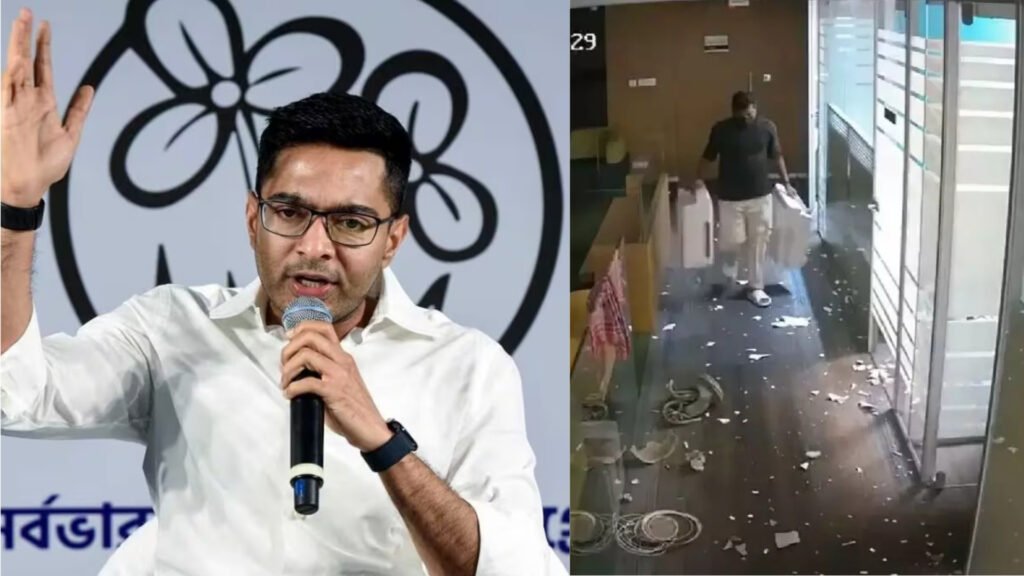
The Trinamool Congress (TMC) office on Camac Street in Kolkata was attacked and vandalized by armed men at around 4:30 a.m. on Thursday, September 3, 2026. The incident has heated up the political atmosphere in West Bengal. TMC MP and National General Secretary Abhishek Banerjee has made serious allegations that Bharatiya Janata Party (BJP) workers were behind the attack. Banerjee also shared CCTV footage on his social media account (X), showing masked men vandalizing the office and taking away electronic items. He released the CCTV footage and stated that the attackers arrived around 4:30 a.m. on Thursday. He further claimed that the armed attackers assaulted employees, snatched phones, broke furniture, scattered items throughout the office, and damaged electronic equipment. TMC leaders alleged that TMC employees and lawyers informed the police via phone and email at the time of the incident and for approximately two hours, but no action was taken for approximately two hours. Abhishek Banerjee wrote on his social media account (X) that we demand the immediate arrest of everyone involved in this attack. We also demand an investigation into who planned, organized, and directed this violence, and why the police failed to take action despite repeated information. No political party or group of armed goons can be above the law. If people can enter a political party office with weapons at 4:30 in the morning, attack people, and vandalize property, even when the police are not present, what is the rule of law left in West Bengal? Enough is enough. Arrest the culprits. Fix accountability. Take action now. He further wrote that this is what the BJP did to my party office early this morning. Will the Governor of West Bengal take action? Will the Union Home Minister take action? Will the PMO take action? Or will they simply continue to ignore it? It’s time for the judiciary, especially the Calcutta High Court, to take serious cognizance of this situation and take steps to maintain the rule of law in West Bengal. And a direct question to Suvendu Adhikari: Why are you so afraid of the Trinamool Congress and me that you have to resort to such intimidation tactics? BJP responds strongly to allegations The Bharatiya Janata Party (BJP) has strongly retorted to the allegations of vandalism at the Trinamool Congress (TMC) office, calling it a “staged drama” by the TMC. BJP MLA Sajal Ghosh said that the entire incident was staged by the TMC itself. He added that the BJP had no involvement in the incident. The TMC currently has no political issues left, so they are only doing this to remain in the limelight. BJP leaders have also questioned the timing of the incident. Sajal Ghosh asked, “What were TMC workers doing in that office so early in the morning (at 4:30 am)?” Kolkata Police have launched an investigation into the matter and detained six people from the scene. CCTV footage is also being examined.
Political Turmoil Deepens in West Bengal: Udayan Guha Held, TMC Faces Rebel MPs Challenge Ahead of Key June 19 Meeting..
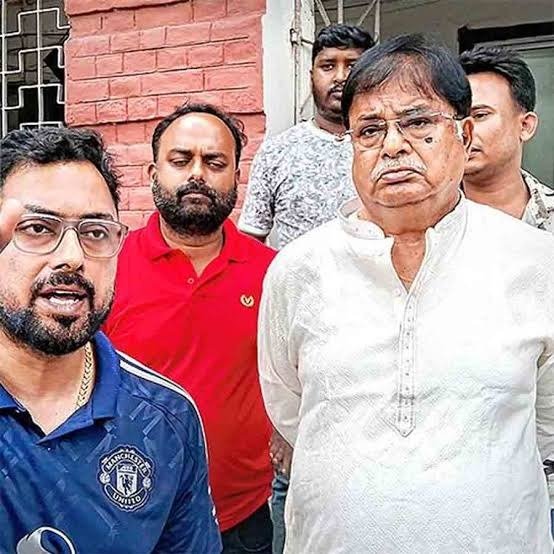
In a significant development, the police arrested Udayan Guha, the former Trinamool Congress (TMC) MLA from Dinhata, from the Phoolbagan area of Kolkata on Wednesday. Officials view this arrest as a major development in state politics. Udayan Guha’s arrest comes at a time when several significant events are unfolding within West Bengal’s political and legal spheres. This move has further heated up the state’s political atmosphere. Meanwhile, sources revealed that Lok Sabha Speaker Om Birla has summoned Trinamool Congress National General Secretary Abhishek Banerjee for a discussion on June 19. The meeting will focus on the 20 dissident TMC MPs and the party’s stance on the entire matter. This issue stems from the growing discontent within the TMC following the assembly elections. Twenty dissident MPs from the party had met Lok Sabha Speaker Om Birla on June 14. During that meeting, the MPs submitted a letter informing him about the merger of their group with the Tripura-based Nationalist Congress Party of India (NCPI). They also requested separate seating arrangements in the Lok Sabha. According to sources, the Lok Sabha Speaker is currently reviewing the status of these 20 MPs. It is reported that he will make a final decision only after hearing all parties involved. Sources further indicated that the summons sent to Abhishek Banerjee follows a previously scheduled meeting that he was unable to attend. According to TMC sources, the Lok Sabha Speaker’s office had sent a meeting notification to Abhishek Banerjee via email on June 15 at 2 PM. There is now considerable interest in political circles regarding the upcoming June 19 meeting, as it could impact the ongoing internal dispute within the TMC and the future of the dissident MPs.
Big Trouble for Mamata Banerjee’s Party…
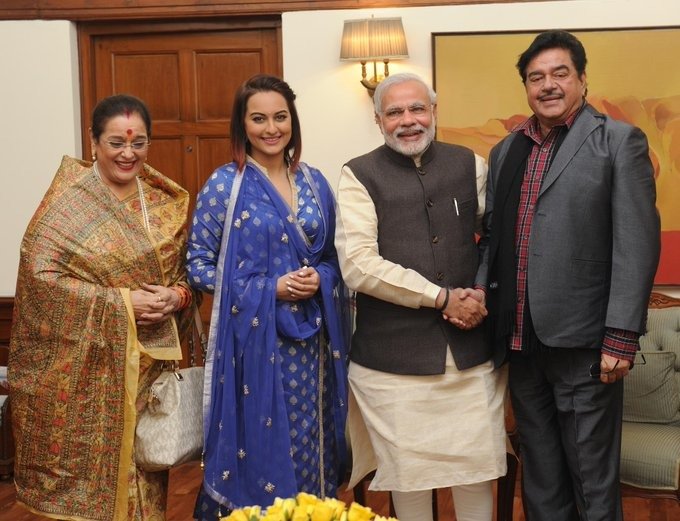
There’s turmoil within Mamata Banerjee’s party, the TMC. Following the crushing defeat in the assembly elections, MLAs and MPs have launched a campaign against Mamata Banerjee. One by one, MLAs and MPs are defecting and speaking openly against Mamata Banerjee. Now, 19 new members have rebelled against the party and submitted a letter to the Lok Sabha Speaker, further exacerbating the problems for the TMC and Mamata Banerjee. The names of Shatrughan Sinha and cricketer Yusuf Pathan have also emerged among those who left the party. Shatrughan Sinha is considered very close to Mamata Banerjee, as Mamata trusted him and fielded Anshul in the elections. Recently, Chitrakoot Singh was seen agreeing with every decision Mamata Banerjee made, but now news of his rebellion is suddenly emerging. According to the helpline of Lok Sabha elections 2024, Trinamool Congress MP from Ansul and Bollywood actor Shatrughan Sinha is the richest MP of West Bengal. According to the helpline filed during the 2024 Lok Sabha elections, his total declared assets are around Rs 210 crore. Earlier in 2019, his total assets were around Rs 112 crore, which means his assets have increased rapidly in 5 years.
From TMC Loyalist to BJP’s Strongest Face, Suvendu Adhikari’s Political Story
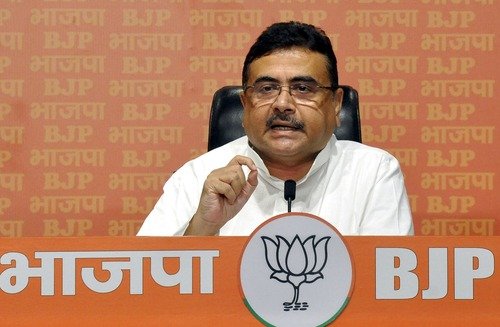
Suvendu Adhikari is considered one of the most prominent political figures in West Bengal today. Known for his strong public presence and influential leadership, he has played an important role in shaping the state’s political environment over the last two decades. His political journey, marked by major shifts and fierce electoral battles, has kept him at the center of Bengal politics. Early Political Journey He was born on December 15, 1970, in Purba Medinipur district, Suvendu Adhikari belongs to a politically active family. His father, Sisir Adhikari, has also been an influential leader in the state. Inspired by public life from an early age, Suvendu gradually built his political career through grassroots involvement and local leadership. He first gained recognition while working with the All India Trinamool Congress under the leadership of Mamata Banerjee. Over time, he became one of the party’s most trusted organizers, especially in the Midnapore region. Rise During the Nandigram Movement Suvendu Adhikari came into the spotlight during the Nandigram Movement in 2007. The protests erupted against a proposed land acquisition project and turned into a major political turning point in West Bengal. Adhikari emerged as one of the leading faces of the movement, connecting strongly with farmers and local communities. The agitation weakened the influence of the Left Front government and strengthened the Trinamool Congress ahead of the 2011 Assembly elections. Joining the BJP In 2020, Suvendu Adhikari made headlines after leaving the Trinamool Congress and joining the Bharatiya Janata Party. His move was viewed as a major political development in the state, as he was considered a powerful regional leader with significant public support. The political rivalry between Adhikari and Mamata Banerjee intensified during the 2021 West Bengal Assembly elections. Contesting from Nandigram, he defeated Mamata Banerjee in one of the most closely followed electoral contests in the country. Present Political Role At present, Suvendu Adhikari serves as the Leader of Opposition in the West Bengal Legislative Assembly. He regularly raises issues related to governance, corruption, law and order, and political violence in the state. Supporters see him as an energetic and determined leader, while opponents often criticize his aggressive political approach. Despite political differences, his influence in Bengal politics remains significant. Suvendu Adhikari’s political career reflects determination, strategic leadership, and strong grassroots connection. From being an important member of the Trinamool Congress to becoming a leading face of the BJP in West Bengal, his journey has been filled with major political developments. As the state’s politics continue to evolve, Adhikari is expected to remain a major player in the years to come.
BJP Leaders Take Oath In Kolkata While Abhishek Banerjee Vows Strong Opposition
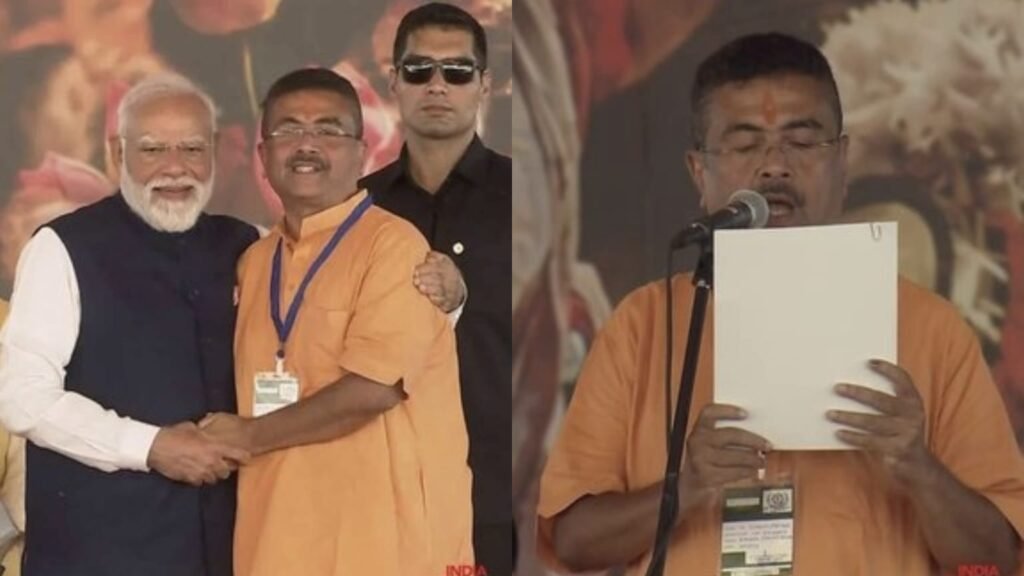
The BJP has scripted history in Kolkata; for the first time since independence, the party has formed its own government. The swearing-in ceremony was held at Kolkata’s Brigade Parade Ground, where Suvendu Adhikari took the oath as the Chief Minister of West Bengal. During the event, Governor R.N. Ravi administered the oath of office and secrecy to Suvendu Adhikari. The ceremony was attended by Prime Minister Narendra Modi, Rajnath Singh, and Amit Shah, alongside several other Union Ministers, Chief Ministers, senior leaders, and thousands of BJP workers and supporters. It is worth noting that, alongside Suvendu Adhikari, five other MLAs also took the oath as ministers; these include Dilip Ghosh, Agnimitra Paul, Ashok Kritaniya, Khudiram Tudu, and Nisith Pramanik. Notably, Dilip Ghosh has previously served as the BJP’s State President in Bengal and currently holds the position of National Vice President of the party. Many prominent BJP leaders were present at Suvendu Adhikari’s swearing-in ceremony. Additionally, leaders and Chief Ministers from the NDA’s alliance partners also attended the event. Senior leaders remarked that the presence of such high-profile figures underscores the significance of the BJP forming its first-ever government in West Bengal. Abhishek Banerjee Vows Strong Opposition While the BJP’s swearing-in ceremony was taking place in West Bengal, Trinamool Congress General Secretary and MP Abhishek Banerjee stated that his party would play the role of a strong, vocal, and uncompromising opposition—both in Delhi and in Bengal. Furthermore, he appealed to Trinamool supporters and workers to remain strong and united during these challenging times. Meanwhile, a festive atmosphere prevailed at Suvendu Adhikari’s residence in Kanthi following his elevation to the post of Chief Minister of Bengal. In Kolkata, BJP workers gathered outside his family home to celebrate the occasion during the swearing-in ceremony.
Political Violence Explodes in Bengal, BJP Leader’s Close Aide Killed
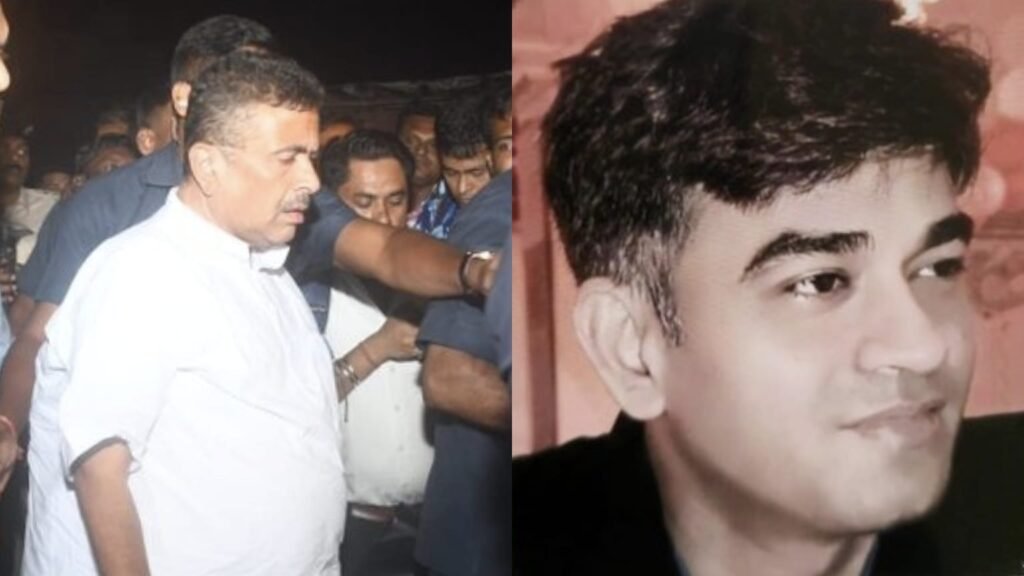
Just before the oath-taking ceremony in West Bengal, a major political violence incident shook the state. BJP senior leader Suvendu Adhikari’s personal assistant, Chandranath Rath (42), was shot dead on Wednesday night around 10:30 PM in Madhyamgram, located in North 24 Parganas district. According to reports, Chandranath was returning home to Madhyamgram from Kolkata in a Scorpio vehicle. He was seated beside the driver, while another person was also inside the vehicle. The attack took place between Tala and Madhyamgram, around 20 kilometers from Kolkata. Reports suggest that a car approached from behind and suddenly blocked the Scorpio’s path. Soon after, an attacker arrived on a motorcycle and opened fire from the left side of the vehicle, firing nearly 6 to 10 rounds. Chandranath Rath was hit by four bullets, including two that pierced through his chest and one in the abdomen. The driver, Buddhadev Ber, was also injured in the firing and remains in critical condition. After the attack, the assailants abandoned the car used to block the road and escaped on the motorcycle. The injured were rushed to a nearby hospital, where doctors declared Chandranath dead. The BJP has accused the TMC of being behind the murder. According to forensic reports, the attackers used a Glock 47X pistol — a modern weapon believed to be used by professional shooters rather than ordinary criminals. Police stated that the attackers were wearing helmets and the motorcycle did not have a number plate. The car used to stop the Scorpio has been seized, and officials suspect its registration number was fake. Nearly an hour after this incident, around 12:30 AM, another BJP worker named Rohit Roy was reportedly shot at in Basirhat district. His condition is also said to be critical. Reports claim that since the election results, five people linked to political violence have lost their lives — including three BJP members and two associated with the TMC. Suvendu Adhikari described the killing as a “planned murder” and appealed to party workers to maintain peace. He also stated that the BJP would begin a crackdown on “goons” in Bengal. Meanwhile, the TMC denied any involvement of its workers in the incident and demanded a CBI investigation into the case.
After Voting, Chaos: EVM Controversy Heats Up Bengal Politics
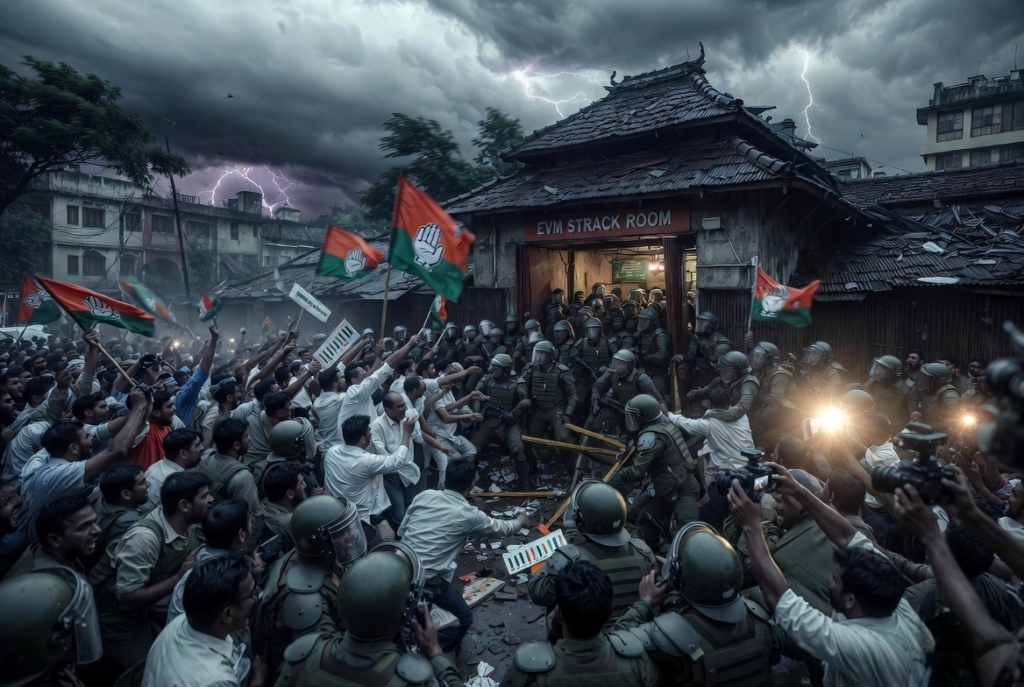
Election-related tensions in West Bengal have escalated beyond the usual patterns of political friction, drawing sharp reactions from parties and observers alike. The ongoing developments have created an atmosphere of uncertainty even after polling in key phases has concluded. On Thursday, workers and leaders of the Bharatiya Janata Party (BJP) and the All India Trinamool Congress (TMC) clashed at multiple locations across the state. Reports indicate heated exchanges between political representatives and local authorities, alongside protests over alleged irregularities in the handling and storage of Electronic Voting Machines (EVMs) in designated strong rooms. In a significant and rare move, Chief Minister Mamata Banerjee visited the strong room at Bhabanipur in Kolkata. Her presence at the site during this sensitive stage of the electoral process has intensified political debate, with opposition parties questioning the intent while TMC leaders defended the move as a step to ensure transparency. The controversy surrounding EVM security, which began on Thursday evening, continued into Friday. The TMC accused the Election Commission of India of acting in a biased manner and favoring the opposition. Escalating the matter legally, the party approached the Supreme Court of India, challenging a decision taken by the Chief Electoral Officer. West Bengal had recorded polling for 142 assembly constituencies in the second phase on April 29. The counting of votes is scheduled for May 4. Traditionally, the intensity of political confrontations subsides after voting concludes, but the current scenario suggests otherwise, with tensions persisting across districts. Political analysts point out that several unprecedented incidents have marked the 2026 Assembly elections in the state. While the BJP and TMC remain locked in a direct confrontation, experts themselves are divided over the fairness and management of the electoral process, reflecting the deeply polarized nature of West Bengal’s political landscape.
EVM Controversy Sparks Security Clampdown in Kolkata Ahead of Results
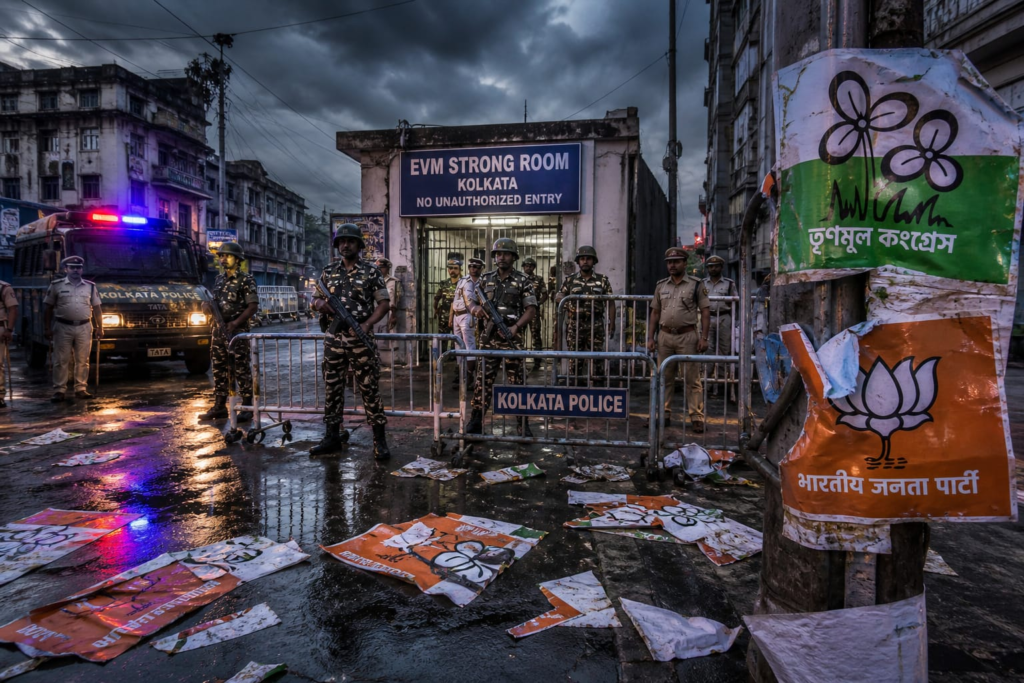
Following a high-voltage controversy over alleged EVM tampering in Kolkata ahead of vote counting, authorities have tightened security and imposed strict restrictions. After Trinamool Congress (TMC) raised concerns about “suspicious activities,” police banned all forms of public gatherings in seven sensitive locations across the city. The restrictions have been enforced in areas including Sahid Khudiram Bose Road, Judge’s Court Road, Jadavpur, Diamond Harbour Road, Lord Sinha Hall, Naresh Mitra Sarani (Beltala Road), and Pramathesh Barua Sarani. Security has also been significantly strengthened around strong rooms where EVMs are stored, as well as at counting centres. At Khudiram Anushilan Kendra, which houses EVMs from several constituencies in north and east Kolkata, additional central forces and armed police personnel have been deployed. Officials stated that the entire area is under close supervision of senior officers. Meanwhile, tensions escalated outside Netaji Indoor Stadium, where workers of the Bharatiya Janata Party (BJP) and TMC engaged in sloganeering and a brief clash. TMC leaders Kunal Ghosh and Shashi Panja staged a protest at the site. Amid the situation, Chief Minister Mamata Banerjee visited the Shakhawat Memorial counting centre and remained there for some time. However, West Bengal Chief Electoral Officer Manoj Kumar Agarwal dismissed the allegations, stating that all strong rooms were sealed properly after polling in the presence of candidates and officials. He clarified that postal ballots were being sorted using torchlight due to the absence of electricity inside strong rooms—a standard protocol—which was misinterpreted as suspicious activity. According to him, the entire process remains secure and transparent, with all stakeholders kept informed.